Residential vs. Datacenter Proxies: Which is Harder for Websites to Detect?
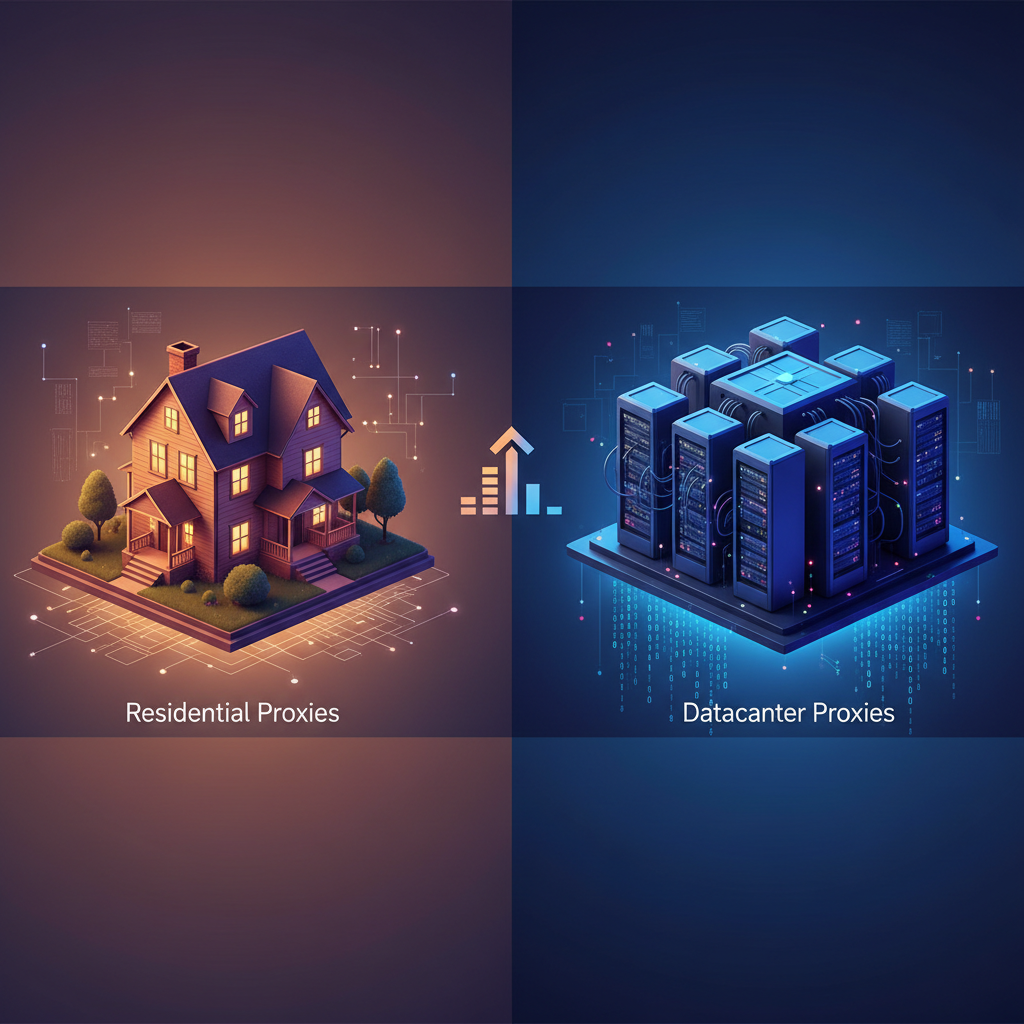
Residential vs. Datacenter Proxies: Which is Harder for Websites to Detect?
TL;DR: Residential proxies are significantly harder for websites to detect because they use IP addresses assigned to real home users by Internet Service Providers (ISPs), appearing as organic human traffic. In contrast, datacenter proxies originate from cloud servers and lack legitimate ISP metadata, making them easy targets for modern security filters. In 2026, the choice depends on your need for speed (datacenter) versus stealth (residential).
As web security evolves in 2026, the arms race between data collectors and anti-bot systems has reached a fever pitch. Whether you are managing multi-accounting, conducting market research, or scraping competitive pricing data, the most critical question remains: which proxy type will keep you under the radar?
The short answer is that residential proxies are much harder to detect. However, the "why" involves a complex interplay of network architecture, IP reputation scores, and the sophisticated ways modern websites analyze user behavior. This guide breaks down the technical differences to help you choose the right tool for your specific use case.
1. Defining the Players: Architecture and Origin
To understand detectability, we must first look at where these IP addresses come from. The origin of an IP tells a website’s security system almost everything it needs to know about the "humanity" of the visitor.
Datacenter Proxies
Datacenter proxies are not affiliated with an Internet Service Provider (ISP). Instead, they are generated in bulk from secondary corporations (data centers like AWS, Google Cloud, or DigitalOcean). Because these IPs are hosted in the cloud, they offer incredible speed and low latency. However, because they belong to known server ranges, they carry a "non-human" flag by default.
Residential Proxies
Residential proxies are IP addresses provided by ISPs to homeowners. When you use a residential proxy, your traffic is routed through a real device—a desktop or a mobile phone—connected to a home Wi-Fi network. To a web server, a residential proxy looks identical to any other person browsing from their living room.
2. Why IP Reputation Scores Matter in 2026
Modern proxy detection systems rely heavily on IP reputation scores. These scores are essentially credit ratings for IP addresses, calculated by security providers like Akamai, Cloudflare, and DataDome.
ISP vs. AS-Type
Every IP address belongs to an Autonomous System (AS). Security systems check the AS-Type of an incoming request. If the AS-Type is "Commercial" or "Data Center," the reputation score takes an immediate hit. If the AS-Type is "ISP" or "Residential," the system grants a higher level of trust.
Blacklisting Frequency
Datacenter IPs are often sold in consecutive blocks (subnets). If one bot on a subnet gets caught scraping a site, the entire range (e.g., 192.168.1.1 through 192.168.1.255) might be blacklisted. Residential IPs, conversely, are scattered across diverse providers and locations, making it impossible for a website to block them without risking the exclusion of legitimate customers.
3. Passive Fingerprinting and TTL Analysis
Detection goes beyond just the IP address. In 2026, websites use "passive fingerprinting" to see if the hardware settings match the IP’s claimed identity.
Time-to-Live (TTL) Values
When a packet of data travels from your computer to a server, it has a TTL value that decreases with every "hop" it takes through a router. Datacenter proxies often have distinct TTL patterns that suggest the traffic is coming from a virtualized environment. Residential traffic, moving through home routers, presents a messy, "human-like" TTL signature that is difficult to flag as automated.
The Role of Protocols
Advanced users often debate HTTPS vs SOCKS protocol when trying to bypass these detection layers. While SOCKS5 is excellent for handling various types of traffic and UDP, the underlying IP reputation remains the primary factor in whether a connection is dropped or challenged with a CAPTCHA.
4. Speed vs. Stealth: The Technical Trade-off
The difficulty of detection is often inversely proportional to performance. While datacenter proxies are easier to spot, they are not obsolete.
- Datacenter Advantage: High bandwidth and sub-100ms response times. These are ideal for high-speed tasks on sites with weak security.
- Residential Advantage: Maximum anonymity. These are essential for "protected" targets like social media platforms, search engines, and sneaker sites.
If you are gathering market intelligence from high-authority domains, the slower speed of a residential proxy is a necessary trade-off to avoid the dreaded "403 Forbidden" error or persistent CAPTCHAs.
5. How Proxy Detection Systems Work in 2026
Websites no longer just look at a list of "bad IPs." They use behavioral and environment analysis to catch even the most sophisticated proxies.
H3: Behavior Analysis
If an IP address visits 500 pages in 10 seconds, it doesn't matter if it's a residential IP; it will be flagged as a bot. Rate limiting is the first line of defense. However, because residential pools are so large, developers can rotate IPs for every request, making it look like 500 different people are visiting one page each.
H3: Browser Fingerprinting
Websites check for consistency between your IP and your browser. If your IP is from London, but your browser’s time zone, language settings, and WebRTC leak suggest you are in New York, you will be detected. This is why many pros use residential proxies in tandem with antidetect browsers to ensure every data point matches perfectly.
6. Use Cases: When to Use Which?
Choosing based on detectability depends entirely on your target.
- E-commerce Scraping: Major retailers have aggressive bot mitigation. Residential proxies are mandatory here to prevent IP bans.
- SEO Monitoring: Search engines are highly sensitive to automated queries. Residential IPs allow you to see localized search results without triggering "Unusual traffic from your computer network" warnings.
- Social Media Management: Creating and managing multiple accounts requires a consistent residential or mobile identity to avoid shadowbans.
- Load Testing: If you are testing your own server's capacity, datacenter proxies are better because they are cost-effective and provide the volume needed to stress-test architecture.
7. The Hybrid Reality: ISP Proxies (Static Residential)
A middle ground has emerged in 2026: Static Residential (ISP) Proxies. These are hosted in datacenters but are registered under ISP names. They provide the speed of a datacenter and the reputation of a residential IP. However, because they are static, they do not offer the "rotation" benefits of a standard residential pool, making them easier to track over a long period if your behavior is not human-like.
8. Summary of Detection Risks
Below is a quick comparison of factors that influence how easily a website can spot you.
| Feature | Datacenter Proxies | Residential Proxies |
|---|---|---|
| Source | Cloud Servers/Data Centers | Real Home Devices (ISPs) |
| Detection Risk | Very High | Very Low |
| IP Reputation | Usually flagged/Poor | High/Trusted |
| Cost | Low | High (Usage-based) |
| Best For | Bulk tasks, non-protected sites | High-res scraping, Social Media |
9. Conclusion
In the battle of residential vs datacenter proxies, residential proxies are the undisputed winners in terms of stealth. Their ability to blend in with legitimate consumer traffic makes them nearly impossible to block without causing significant collateral damage to a website's real user base.
However, detection isn't just about the IP. Even the best residential proxy cannot save you from detection if your browser fingerprint is inconsistent or if your request patterns are overly aggressive. Success in 2026 requires a holistic approach: high-quality residential IPs, proper rotation logic, and a clean browser environment.
Concluzii cheie
- Residential IPs are harder to detect because they are assigned by legitimate ISPs to real households.
- Datacenter IPs are easily flagged due to their association with server farms and commercial IP ranges.
- IP Reputation Scores act as a gatekeeper; residential IPs naturally have higher trust scores.
- Detection is multi-layered: Modern systems analyze IP type, TTL values, and browser fingerprints simultaneously.
- Use Datacenter for speed on low-security targets; use Residential for stealth on highly protected platforms.