Top 3 hproxy.com Alternatives for Proxy Services 2026

Managing web scraping, ad verification, and regional app testing with residential and mobile proxies often stalls because providers either require long-term contracts or hide granular controls for session and geo-targeting behind opaque pricing. Many services present friction through mandatory account sign-up just for rates, confusing proxy types, or unreliable protocol and country coverage that only surfaces after deployment. This comparison breaks down how top alternatives to hproxy.com handle billing flexibility, IP diversity, and technical controls so you can pick a proxy vendor that fits your project’s volume, location, and automation requirements.
Table of Contents
HydraProxy
At a Glance
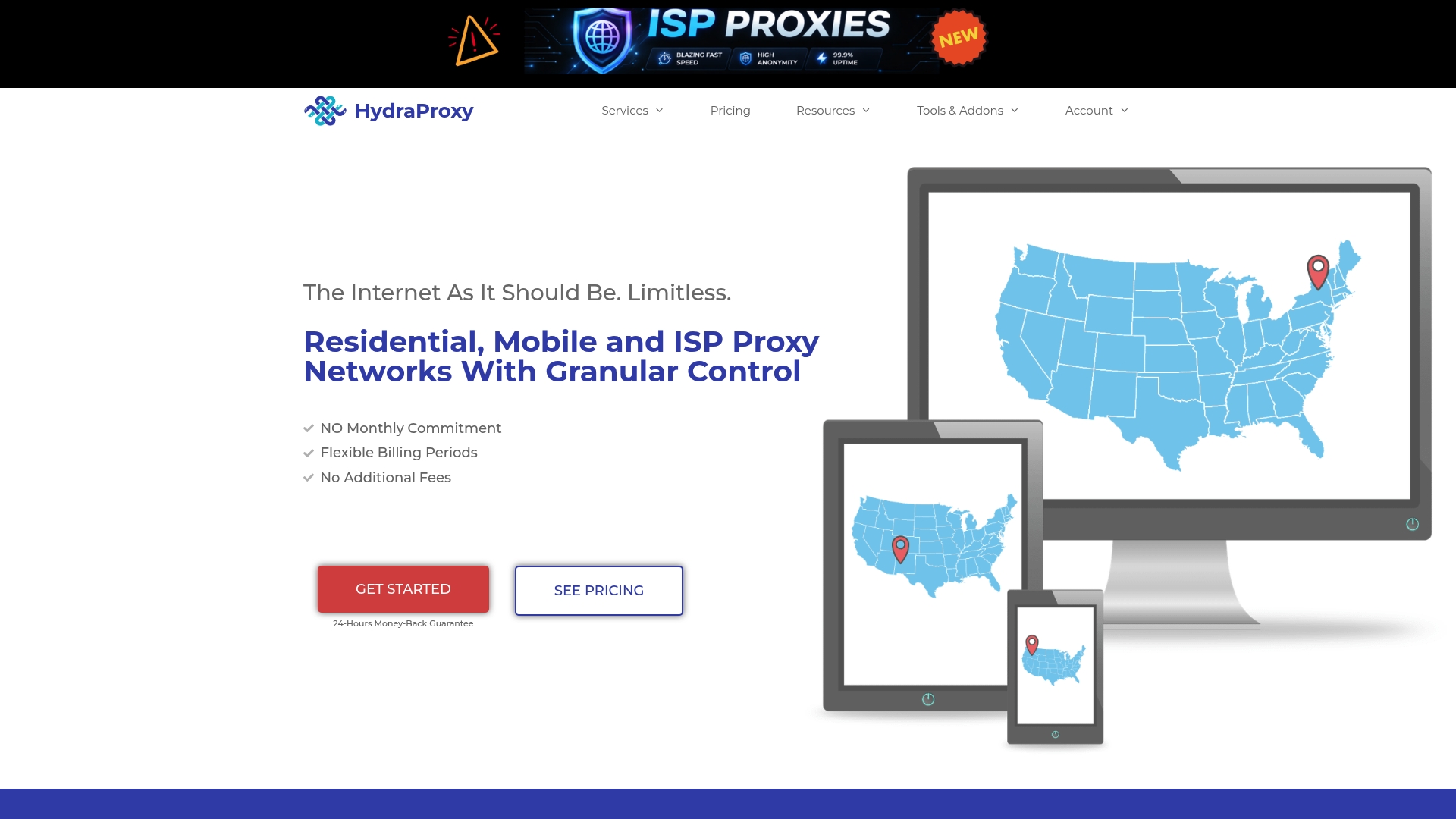
Hydraproxy reports over 5 million IPs spanning residential, mobile, static, and ISP pools, a scale aimed at large crawls and multi-region testing. The service combines granular session control with flexible billing and no monthly commitments so teams can run short tests without long contracts.
Core Features
-
Large mixed pool: that figure above covers residential, mobile, static mobile, and ISP IPs for different detection profiles and carrier behavior.
-
Protocols and session control: mobile proxies support HTTP/HTTPS and SOCKS while residential proxies support HTTPS only. You get rotating or sticky sessions and multiple authentication methods.
-
Precise geo-targeting: country and US state-level targeting for mobile, country-level for residential, ZIP code filtering for static mobile, and ISP targeting for ISP proxies.
-
Flexible billing and onboarding: pay-as-you-go style pricing with no monthly commitments and account-based quotes. The vendor advertises extensive tutorials and support resources for setup.
Key Differentiator
The standout is the platform’s emphasis on granular control across rotation, stickiness, and geo-targeting combined with multi-protocol support. That combination lets you model real user diversity rather than relying on a single proxy type.
This control is tailored for sensitive workflows where session behavior, carrier characteristics, or exact geographic placement matter, such as carrier-specific mobile testing or state-level ad verification.
Pros
-
High pool diversity supports aggressive scraping strategies. Multiple IP categories reduce the risk of uniform fingerprinting and help you switch tactics quickly.
-
Billing model removes upfront commitment. You can validate scrapes or short campaigns without a monthly plan or long-term contract.
-
Detailed session controls let you choose rotating or sticky IPs per task. That flexibility matters when you need both burst crawls and long-lived sessions for account-based testing.
-
Protocol coverage fits mixed workflows. Mobile SOCKS support plus HTTPS residential proxies cover most scraping and app-testing needs.
-
Documentation and support resources speed adoption. Built-in tutorials and responsive support reduce integration time for engineering teams.
Cons
- Pricing requires account registration to see detailed quotes, which adds friction if you want immediate price transparency.
Who It’s For
Organizations, enterprises, and developer teams running geo-targeted data collection, ad verification, or mobile app QA. If you need state-level or ZIP-level targeting and the ability to emulate carrier behavior, this product matches that technical requirement.
Unique Value Proposition
Flexible billing with no monthly commitments lets you run seasonal crawls, proof-of-concept scrapes, or short-term market research without committing to a recurring plan. For teams validating vendors or experiments, that billing model reduces procurement friction and financial risk.
The operational impact is clear. You can spin up targeted crawls, measure results, and shut them down without amortizing a monthly fee across uncertain outcomes.
Real World Use Case
A marketing agency uses Hydraproxy’s residential pool to scrape regional e-commerce prices across several countries. They route mobile checks through state-targeted mobile proxies to verify carrier-specific app behavior. The mixed pool and session controls reduce IP bans and prevent location mismatches during reporting.
Pricing
Pricing varies by proxy type and requested volume. The vendor states detailed pricing is provided after account registration, with a flexible, no-monthly-commitment billing model that favors pay-as-you-go or volume-based arrangements.
Website: https://hydraproxy.com
IPRoyal
At a Glance
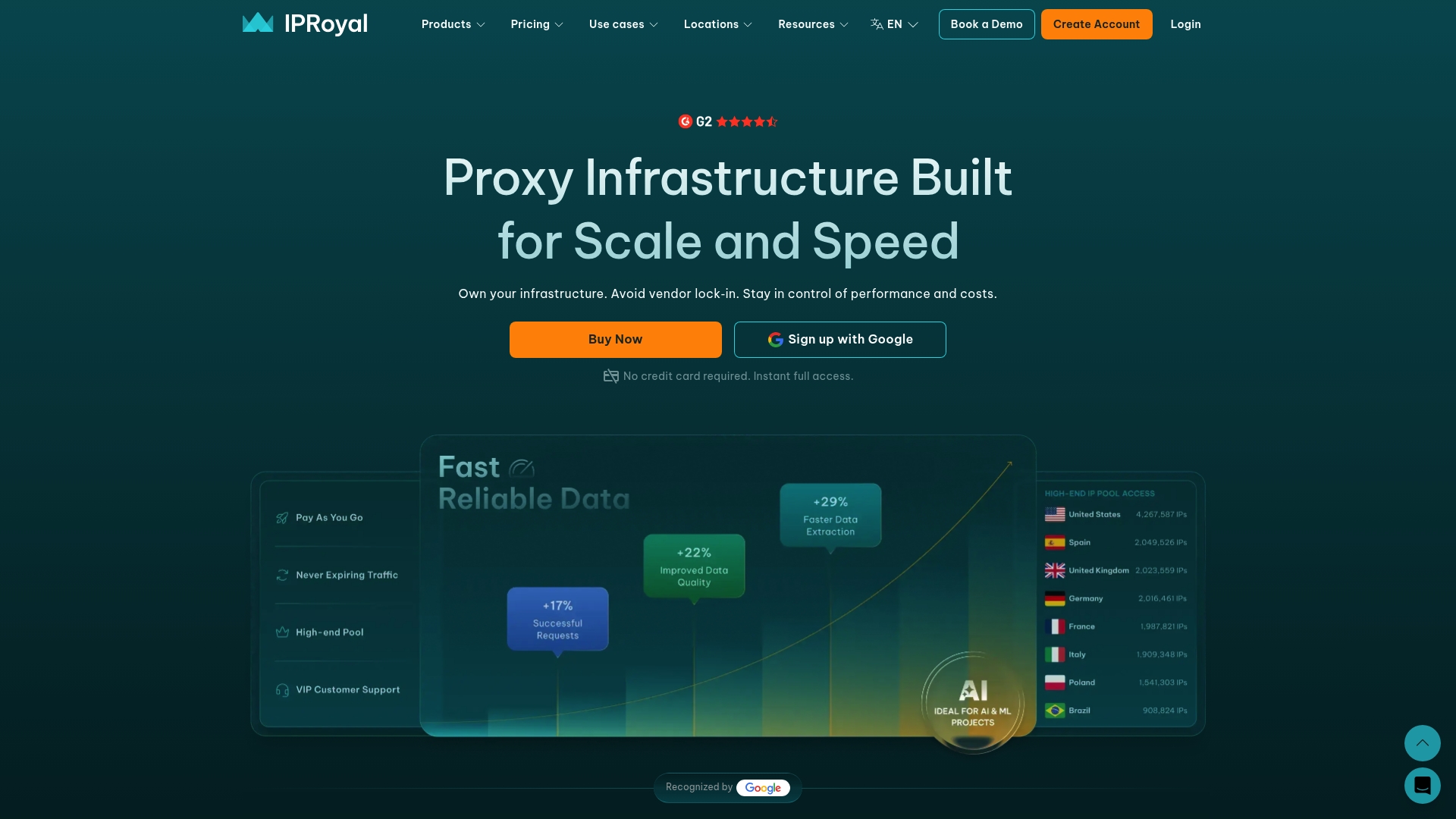
IPRoyal’s marketing materials advertise a proxy pool of over 32 million IPs across 195 countries, with a claimed success rate near 99.4% and an average response time of about 0.5s. That scale supports both pay-as-you-go and subscription usage models.
Core Features
Support for residential, datacenter, ISP, and mobile proxies gives you protocol and location flexibility for scraping, testing, and verification tasks.
The platform exposes an API plus integrations for automation and third-party tools, and it offers manual and automatic IP rotation to balance anonymity with session stability.
Flexible plans include hourly, daily, and GB billing so teams can optimize cost for bursts or steady volume.
Key Differentiator
IPRoyal emphasises owning its infrastructure and a very large global footprint, which the vendor says enables broader geographic reach and higher concurrency than many resellers. That engineering-first approach fits teams that need raw scale rather than a small curated residential pool.
Compared with Hydraproxy, which focuses on session control and mixed mobile/residential options, IPRoyal leans toward high-volume automation and enterprise customization.
Pros
-
Helpful, responsive customer support reported by users, which speeds troubleshooting and onboarding for complex setups.
-
High-speed connections and a high success figure cited in vendor materials, useful when you need predictable request throughput.
-
Affordable, flexible pricing with pay-as-you-go options, which reduces upfront commitment for intermittent scraping or verification jobs.
-
Very wide geographic coverage across 195 countries, making region-specific testing and ad verification feasible without juggling multiple providers.
-
No long-term contracts, so you can scale up for a campaign then scale down without retention penalties.
Cons
-
Several users report proxy detection and flagging that reduce reliability for sensitive scraping or account-sensitive automation.
-
Misconfiguration risks can lead to IP leakage or weaker privacy unless you follow strict network and client settings.
-
The ordering process and proxy type selection can be confusing; some customers describe mismatches between what they ordered and what they received.
-
Support experiences are mixed: while many users praise fast help, others report slow responses or refund friction in edge cases.
When It May Not Fit
If your project cannot tolerate any detection or requires guaranteed stealth for account-sensitive automation, that reported detection risk makes IPRoyal a risky primary choice.
If you lack a technical team to lock down client settings and routing, privacy and leakage concerns could create liability or data quality problems.
Notable Integrations
The vendor advertises support for 650+ tools, including anti-detect browsers, automation platforms, and common data-collection stacks. That breadth helps reduce custom glue code when you link proxies to orchestration or scraping frameworks.
Who It’s For
Companies and developers who need high-volume, scalable proxy capacity with global reach and API control. Best for teams that automate large scraping jobs, run distributed ad verification, or need many concurrent regional sessions.
Real World Use Case
A marketing agency uses IPRoyal residential proxies and the API to run geo-targeted ad verification across multiple countries. They automate tests, collect regional creatives, and rotate IPs to avoid local rate limits during intensive campaigns.
Pricing
Residential proxies start at the vendor-stated rate of $1.75 per GB with bulk discounts down to $1.39 per GB. Datacenter proxies begin around $1.39 per proxy and mobile proxies start at about $10.11 per day according to the pricing information provided.
Website: https://iproyal.com
Infatica
At a Glance
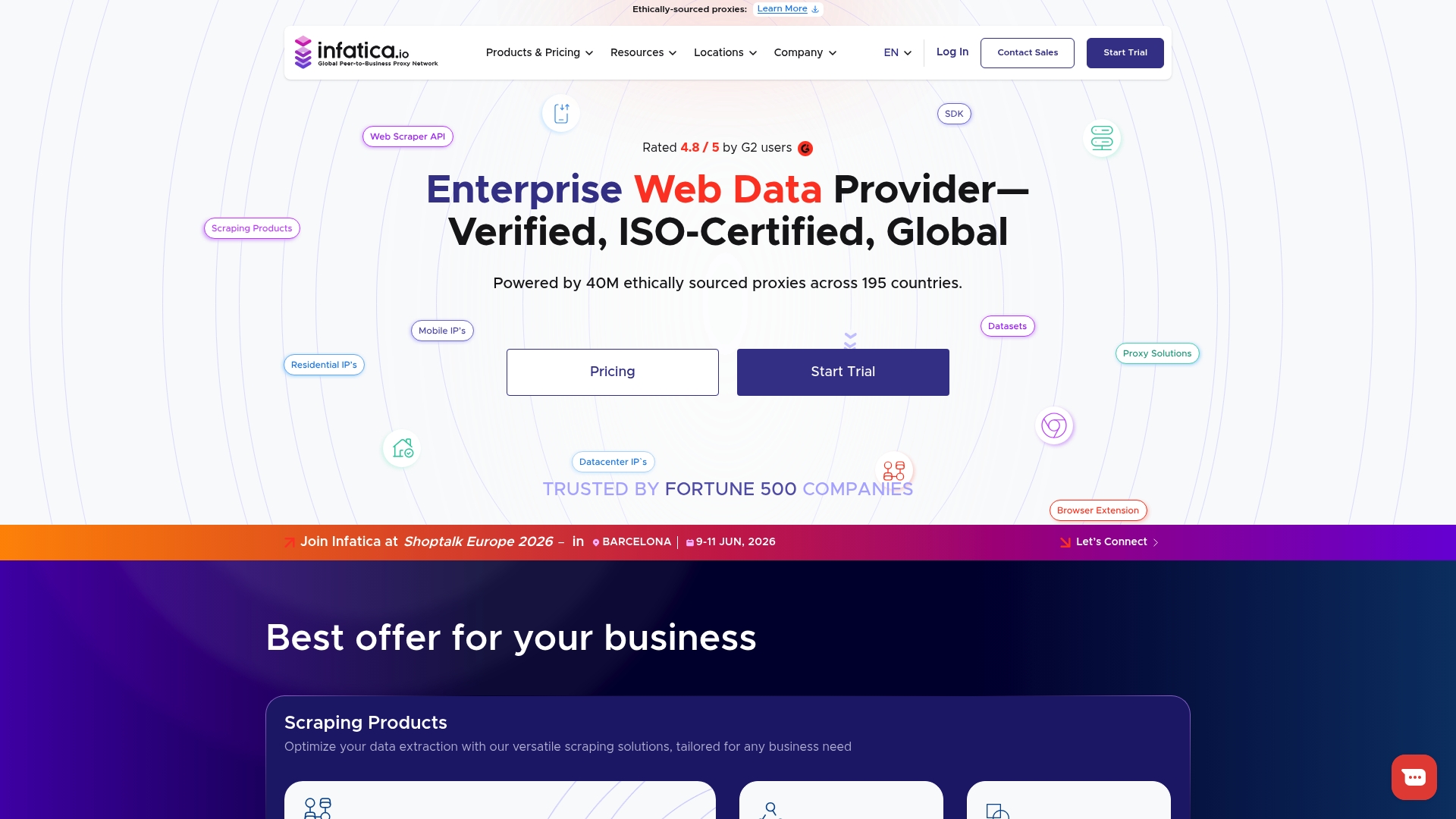
Infatica advertises a global pool of over 40 million proxies across 195 countries, paired with API-driven scraping and ready-made datasets. That scale and the dataset focus position the product as a data pipeline partner for teams that need broad geographic reach and programmatic extraction.
Core Features
- Large distributed proxy network covering many geolocations and proxy types including residential, IPv6, static ISP, data center, and mobile IPs.
- Scraping APIs that support JavaScript rendering, geotargeting, and CAPTCHA handling to reduce engineering work on request orchestration.
- Pre-structured datasets for verticals like social media, eCommerce, and jobs to speed time to insight.
- Flexible billing with pay-as-you-go and bulk packages plus custom enterprise plans for high-volume customers.
Key Differentiator
Infatica combines a globally distributed, ethically sourced proxy pool with API-first tools and packaged datasets. That mix narrows the product toward enterprise scale data collection rather than a DIY proxy toolbox. Compared with Hydraproxy, Infatica emphasizes programmatic extraction and dataset delivery over session-level billing and per-session control.
Pros
- Fast rollout and developer-friendly APIs make it straightforward to embed extraction into existing pipelines and cron jobs.
- Broad protocol and location support helps bypass geoblocks and test localized results across many markets.
- The vendor reports enterprise adoption including Fortune 500 customers and states a 4.8/5 G2 rating, which suggests strong enterprise interest.
- Offers ready datasets that remove the need to build scrapers for common categories like product listings and social media.
- 24/7 support and flexible volume options reduce operational friction during scaling.
Cons
- Several users report unexpected charges and account blocks, pointing to possible billing or account management friction.
- The platform’s breadth of options can overwhelm non-technical teams who lack a dedicated integration resource.
- API integration and initial setup require developer time; inexperienced users will likely need support.
When It May Not Fit
If you need a turnkey point-and-click proxy manager for occasional browsing or QA, Infatica’s enterprise API focus will feel heavyweight. Organizations worried about irregular billing should test with small volumes first because some reviews mention billing surprises and account restrictions.
Who It’s For
Business analysts, data scientists, SEO teams, marketing agencies, and enterprise data squads that run continuous or large scale scraping jobs and require programmatic control, multi-country coverage, and packaged datasets rather than a purely manual proxy interface.
Real World Use Case
A retail analytics firm uses Infatica’s residential proxies and scraping API to pull competitor prices across multiple countries in near real time. The packaged datasets speed aggregation, while the API handles JavaScript pages and CAPTCHA challenges so the team delivers timely pricing reports.
Pricing
Infatica’s published plans start at $4 per GB for pay-as-you-go usage, with volume discounts and annual billing options. The vendor also offers custom enterprise packages for sustained high throughput and negotiated SLAs.
Website: https://infatica.io
[PLACEHOLDER]
Residential and Mobile Proxies Comparison
This table compares leading proxy service providers to identify the best options for diverse and targeted proxy needs.
| Product Name | Key Differentiator | Proxy Pool Size | Pricing | Notable Limitation |
|---|---|---|---|---|
| Hydraproxy | Granular session and geo-targeting control | Over 5 million | Not disclosed | Pricing details require registration |
| IPRoyal | Ownership of infrastructure and global scale | Over 32 million | Residential from $1.75/GB | Potential detection in sensitive projects |
| Infatica | API-first approach with scraping datasets | Over 40 million | Plans start at $4/GB | Account management complexities reported |
Discover Why Hydraproxy Stands Out Among hproxy.com Alternatives
When searching for reliable proxy services, challenges like limited session control, geographic targeting, and inflexible billing models can slow down your workflows. Hydraproxy addresses these pain points by offering a vast selection of residential, mobile, and ISP proxies designed for high anonymity and precise session management. Whether you need rotating or sticky IPs, multi-protocol support, or state-level geo-targeting, Hydraproxy gives you granular control without long-term commitments.
Ready to reduce guesswork and elevate your data collection or ad verification projects? Explore expert guidance in the Academy Archives – HydraProxy and get answers fast via the Knowledgebase Archives – HydraProxy. Visit Hydraproxy.com to instantly access a flexible proxy network that matches your exact needs. Start your next targeted crawl with confidence by leveraging Hydraproxy’s session control features and pay-as-you-go model.
Frequently Asked Questions
How does Hydraproxy’s flexible billing approach benefit short-term projects?
Hydraproxy’s flexible, pay-as-you-go billing allows teams to run short tests without long-term commitments. This feature is particularly advantageous for seasonal crawls or proof-of-concept scrapes. You can try out different scraping strategies without the pressure of a monthly fee.
What is the difference between IPRoyal and Hydraproxy when it comes to pricing?
IPRoyal offers competitive pricing starting at $1.75 per GB with bulk discounts available, making it suitable for high-volume users. In contrast, Hydraproxy provides a no-commitment billing model that allows for short-term testing without worrying about long contracts. Depending on your needs, you can choose IPRoyal for structured pricing or Hydraproxy for flexibility.
Which platform provides better geo-targeting options for mobile proxies?
Hydraproxy provides precise geo-targeting options, offering country and state-level targeting for mobile proxies, which enhances its effectiveness for localized tasks. This level of detail helps meet specific testing requirements, making it easier to emulate real-user scenarios for campaigns. If precise geo-targeting is critical for your work, consider using Hydraproxy.
Can I use IPRoyal for sensitive scraping tasks?
While IPRoyal is noted for high volume and speed, it carries a reported risk of proxy detection that could affect sensitive scraping tasks. As such, if your project requires guaranteed anonymity, you may want to consider Hydraproxy, which emphasizes granular control and session characteristics suitable for delicate workflows.
What are Hydraproxy’s unique features for session management?
Hydraproxy offers detailed session controls, allowing users to choose between rotating or sticky IPs per task. This flexibility is vital for workflows that need a mix of short bursts and long sessions, such as account-based testing or data collection. Teams looking for customizable session behavior should explore Hydraproxy’s offerings.