Why ISP proxies outperform datacenter proxies for marketers

Datacenter proxies have long been the default choice for web scraping and digital marketing operations, largely because they’re fast and affordable. But speed alone doesn’t determine whether your campaign succeeds or fails. Modern websites use sophisticated detection systems that identify and block datacenter IP ranges almost instantly, leaving your scripts returning errors instead of data. This guide breaks down exactly how ISP proxies work, why they outperform datacenter proxies on the metrics that actually matter, and how to build a proxy strategy that delivers consistent, usable results for scraping, ad verification, and geo-targeted research.
Table of Contents
- How ISP proxies and datacenter proxies really work
- Key reasons ISP proxies outperform datacenter for real-world tasks
- When datacenter proxies still matter: Understanding the limits
- How to benchmark proxies and optimize your stack for success
- The uncomfortable truth about proxy success rates
- Unlock smarter web access with advanced proxy solutions
- Frequently asked questions
Key Takeaways
| Point | Details |
|---|---|
| ISP proxies combine legitimacy and speed | They use residential IP registration with server infrastructure, making them tough to detect and highly performant. |
| Success rate trumps raw speed | Marketers and analysts should focus on usable outcome rates, not just connection speed, to get reliable data and ROI. |
| Datacenter proxies suit low-risk, high-volume tasks | For targets with minimal bot protection, datacenter proxies can be more cost-effective until block rates rise. |
| Benchmark proxies before scaling | Always test proxies on real projects, watching for bans and slowdowns, and adapt your mix as targets evolve. |
| Continual adaptation is vital | Proxy strategies require ongoing review since site defenses and business needs change constantly. |
How ISP proxies and datacenter proxies really work
Understanding the technical difference between these two proxy types is the foundation for making smarter infrastructure decisions. The distinction goes deeper than just speed or price.
Datacenter proxies are IP addresses assigned to servers hosted in commercial data centers. These IPs are registered to cloud providers or hosting companies, not to residential internet service providers. When a target website performs an ASN (Autonomous System Number) lookup on a datacenter IP, it immediately identifies the IP as belonging to a commercial hosting block. That’s a strong signal that the request is automated, not human.
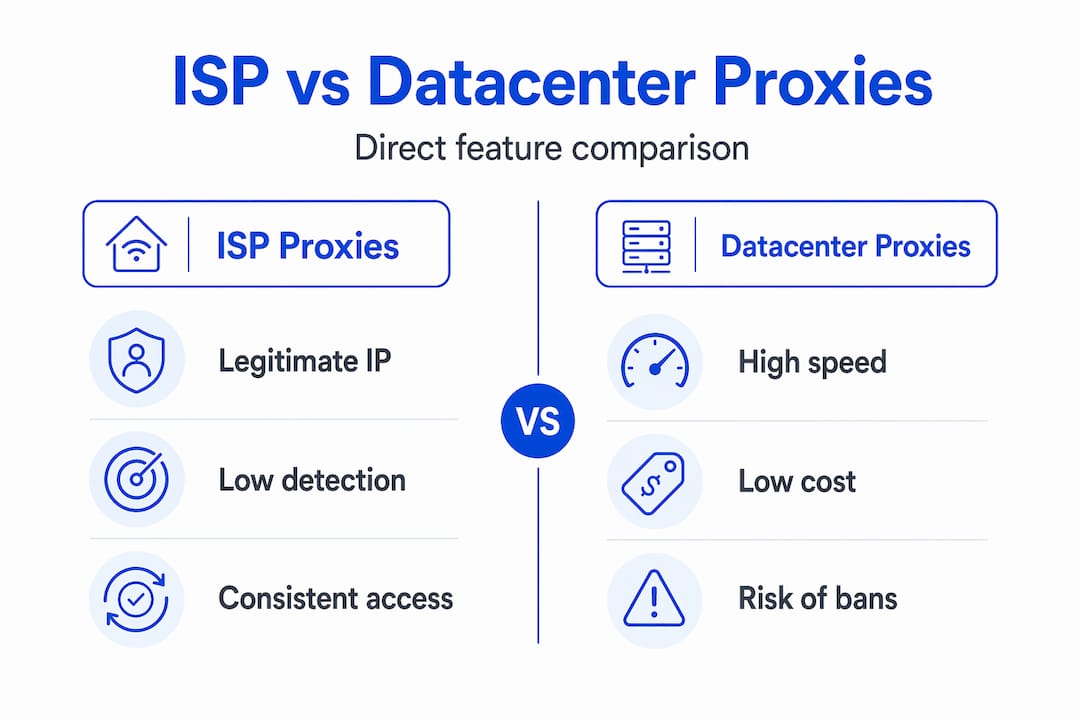
ISP proxies take a different approach. ISP proxies use IPs registered to real ISPs but are server-hosted, combining authenticity and speed. The IP address looks like it belongs to a regular consumer broadband connection, but the actual traffic routes through a high-performance server. That combination is what makes them effective.
To understand why this matters, consider how web servers evaluate incoming requests. They don’t just check your IP address in isolation. They run several checks simultaneously:
- ASN reputation checks: Is this IP block associated with a known data center or a residential ISP?
- IP range analysis: Is this IP part of a subnet that’s been flagged for automated activity?
- Behavioral signals: Does the request pattern match typical human browsing behavior?
- Blacklist lookups: Has this IP appeared on known bot or spam databases?
Datacenter proxies fail the first two checks almost by design. Their IP blocks are widely documented, and many are pre-loaded into commercial bot detection databases. ISP proxies, by contrast, pass ASN checks because their IPs are genuinely registered to consumer broadband providers.
For a clearer comparison, here’s how the two types stack up across key technical dimensions:
| Feature | ISP proxies | Datacenter proxies |
|---|---|---|
| IP registration | Real ISP (consumer broadband) | Data center / cloud provider |
| ASN classification | Residential/ISP | Commercial/hosting |
| Detection risk | Low to moderate | High on protected sites |
| Connection speed | High (server-hosted) | Very high |
| Cost per IP | Moderate to high | Low |
| Block rate on protected sites | Low | High |
| Best use case | Ad verification, scraping, geo-access | Open data, low-protection targets |
If you want a deeper breakdown of how these proxy types compare to mobile options, the proxy differences explained guide covers the full spectrum. For teams focused on data collection at scale, the residential proxies overview provides additional context on IP trust levels.
Key reasons ISP proxies outperform datacenter for real-world tasks
With the basics established, let’s look at the specific, real-world reasons ISP proxies drive more successful marketing and analytics operations than datacenter alternatives.
The most important shift in thinking here is moving away from raw connection speed as your primary metric. What actually determines the value of a proxy for business operations is the usable success rate: the percentage of requests that return valid, actionable data without being blocked, challenged, or served misleading responses.

A datacenter proxy might complete a request in 80 milliseconds. But if 40% of those requests return CAPTCHAs, error pages, or honeypot data, your effective throughput is far lower than a slightly slower ISP proxy with a 95% clean success rate. ISP proxies blend residential IP authenticity with server-host performance, while datacenter proxies are more likely to face bans on protected sites.
Here are the primary functional advantages ISP proxies deliver for marketers and analysts:
-
Higher pass rates on bot detection systems. Services like Cloudflare, DataDome, and PerimeterX maintain extensive databases of known datacenter IP ranges. ISP proxies, because their IPs are registered to legitimate consumer ISPs, are far less likely to trigger these filters on the first request.
-
More reliable access for ad verification. Ad fraud detection and verification workflows require viewing ads as a real user in a specific location. Datacenter IPs are frequently flagged or served modified content, making verification results unreliable. ISP proxies deliver the geographic targeting and IP trust level needed for accurate ad audits.
-
Lower total cost per usable data point. A datacenter proxy plan may cost less per IP, but if your success rate drops to 60%, you’re paying for a large volume of failed requests. ISP proxies typically deliver a lower effective cost per clean data point when you account for retry overhead, time lost to challenges, and the engineering cost of handling errors.
-
Consistent session stability. Many scraping and automation workflows require maintaining a session across multiple page requests. Datacenter IPs that get flagged mid-session force a reset, breaking workflows and corrupting data sets. ISP proxies maintain cleaner sessions on protected targets.
-
Geo-targeting accuracy. For teams running market research or travel fare aggregation across specific regions, ISP proxies provide accurate location signals that match the ISP’s registered geography. This matters when the target site serves different content or pricing based on the user’s apparent location.
As Use Apify notes, datacenter proxies may win on speed and cost if detection risk is manageable, but success is measured by usable data, not just request volume. That framing is exactly right. For efficient web scraping at scale, success rate is the metric that drives ROI.
Pro Tip: Always benchmark proxies directly against your real target sites before committing to a proxy type. Run identical workflows on both ISP and datacenter proxies for 24 to 48 hours and compare usable success rates, not just connection speeds. The results often surprise teams that have been defaulting to datacenter proxies for years. More detail on this is available in our web scraping proxy tips guide.
When datacenter proxies still matter: Understanding the limits
Despite the strong performance edge of ISP proxies for advanced targets, there are still situations where datacenter proxies play a useful and cost-effective role. Knowing when to use each type is what separates a strategic proxy stack from a one-size-fits-all approach.
Datacenter proxies remain a practical choice in these specific scenarios:
- Mass open-data scraping on unprotected targets. Government databases, academic repositories, and many public directories don’t run aggressive bot detection. On these targets, datacenter proxies deliver high speed at low cost with minimal block risk.
- Internal testing and QA workflows. When testing your own web infrastructure or running load simulations, datacenter proxies provide the volume and speed you need without paying a premium for residential trust.
- Speed-critical tasks with low detection exposure. If your workflow requires extremely high request throughput and the target site doesn’t employ advanced bot mitigation, datacenter proxies can handle the load efficiently.
- Budget-constrained exploratory research. Early-stage research where you’re evaluating whether a data source is worth pursuing can be done with datacenter proxies before committing to a premium ISP setup.
The key threshold to monitor is your success rate. As Use Apify notes, datacenter proxies still win in speed and cost on low-protection targets when you measure effective cost per usable data. But once your success rate dips below 85 to 90%, the economics shift. At that point, the cost per clean data point often exceeds what you’d pay for ISP proxies.
Here’s a practical decision framework based on success rate thresholds:
| Success rate | Proxy recommendation | Action |
|---|---|---|
| 95%+ | Datacenter proxies viable | Continue monitoring |
| 85 to 94% | Evaluate ISP proxies | Run parallel benchmark |
| 70 to 84% | Switch to ISP proxies | Immediate review needed |
| Below 70% | ISP or residential required | Datacenter not cost-effective |
The right approach is data-driven. Track your ban rate, error rate, and challenge rate per proxy type and per target domain. Adjust your proxy stack based on what the numbers show, not on assumptions about what should work. For teams running proxies for data automation, this kind of ongoing monitoring is standard practice.
How to benchmark proxies and optimize your stack for success
Knowing where each proxy type fits creates a strategic edge. Here’s how to rigorously select, benchmark, and refine your proxy mix for consistent campaign reliability.
Effective benchmarking isn’t just running a speed test. It requires simulating your actual production workflow against your real target sites. As Use Apify notes, the effective methodology is to benchmark proxies against real-world targets for usable success rate and response time, not just speed. Follow this structured process:
-
Define your target list. Identify the specific domains your campaigns depend on. Group them by detection sophistication: low-protection open sites, medium-protection sites with basic bot filters, and high-protection sites using advanced systems like Cloudflare or DataDome.
-
Set your key metrics. For each target group, track: successful request rate (clean data returned), challenge rate (CAPTCHAs or JS challenges triggered), block rate (hard 403/429 responses), average response time, and retry overhead per 1,000 requests.
-
Run parallel tests. Deploy identical scraping or automation workflows using both ISP and datacenter proxies simultaneously. Use the same request volume, headers, and session patterns. Run tests for at least 48 hours to capture variation across time-of-day and target-side rule changes.
-
Calculate effective cost per usable data point. Divide your total proxy cost for the test period by the number of clean, usable responses. This single metric tells you more than any speed benchmark.
-
Adjust your proxy stack based on results. For high-protection targets, allocate ISP proxies. For open targets, datacenter proxies may still be the efficient choice. Build a tiered stack that routes requests to the appropriate proxy type based on target classification.
-
Refresh benchmarks regularly. Target sites update their detection rules frequently. A proxy setup that delivers 95% success today may drop to 70% in three months if the target deploys a new bot mitigation layer.
“A low-success cheap proxy often costs more per usable data than a premium ISP setup.”
This is the core principle that should guide every proxy purchasing decision. The line-item cost of a proxy plan is almost never the right number to optimize. The right number is cost per clean, actionable data point delivered to your pipeline. For detailed proxy testing methods, we’ve put together step-by-step resources to help you build this process into your standard operations.
Pro Tip: Don’t rely on vendor-provided speed benchmarks or synthetic test results. Run your benchmarks on your actual campaigns, against your actual targets, using your actual request patterns. Vendor tests are run under ideal conditions that rarely reflect real-world scraping environments.
The uncomfortable truth about proxy success rates
After working with both proxy types across a wide range of use cases, one pattern stands out clearly: most teams are optimizing for the wrong variable.
Speed and price per IP are easy to compare. They show up on a pricing page. They’re simple to put in a spreadsheet. But they don’t tell you whether your campaign will actually work. The real limiter is practical usability under scrutiny, and that’s much harder to measure without intentional benchmarking.
Many businesses overspend on large pools of datacenter IPs and still suffer from poor data quality because they never measured their actual success rate. They see high request volume in their logs and assume the system is working. But a significant portion of those requests are returning misleading responses, honeypot data, or error pages that look like valid responses to an untrained pipeline.
The true cost of a poor proxy strategy isn’t the service line item. It’s the missed business: incorrect market intelligence, failed ad verification audits, incomplete competitive pricing data, and engineering time spent debugging what appears to be a scraping problem but is actually a proxy problem.
The solution is to build regular benchmarking into your operations as a standard practice, not a one-time setup task. Target defenses evolve constantly. What worked six months ago may be failing today. Understanding the real proxy differences between proxy tiers is the starting point, but ongoing testing is what keeps your stack performing.
Stay agile. Expect change. Measure what matters.
Unlock smarter web access with advanced proxy solutions
If this breakdown has clarified where your current proxy setup may be falling short, the next step is finding infrastructure that matches your actual operational requirements.
At HydraProxy, we offer ISP, residential, and mobile proxy networks built for teams that need consistent, high-success access to protected targets. Whether you’re running ad verification workflows, competitive price monitoring, or large-scale data collection, our proxy pools are designed to deliver the usable success rates that matter for real business outcomes. Explore our residential proxy solutions to find the right fit for your volume and risk profile, or review our guide on what to look for in a residential proxy before making your decision. No monthly commitments and a money-back guarantee make it straightforward to test against your actual targets.
Frequently asked questions
What are ISP proxies and how do they differ from datacenter proxies?
ISP proxies use IPs registered to real internet service providers but are hosted on servers, so they combine residential trust with server-level performance. Unlike datacenter proxies, which use commercial data center IP blocks that bot detection systems recognize immediately, ISP proxies are server-hosted but carry real ISP-allocated IPs that pass ASN reputation checks.
Are ISP proxies always better than datacenter proxies?
Not always. ISP proxies are the superior choice for bypassing strict bot filters and accessing protected targets, but datacenter proxies win on raw speed and cost when targets have minimal protection and detection risk is low.
How do I know which type of proxy to use for my campaign?
Benchmark both proxy types against your actual targets and measure usable success rate alongside response time. The best methodology is real-world testing on your specific workflows, not relying on synthetic speed comparisons.
What factors can cause even ISP proxies to get blocked?
Repeated use patterns on the same IP, poor prior reputation of a specific IP, or updated detection rules on the target site can all result in blocks. Consistent monitoring and rotating your IP pool helps maintain clean access over time.
Is it worth paying more for ISP proxies?
For business-critical tasks where clean data and low ban rates directly affect revenue or decision quality, yes. Effective cost is about usable data, not just proxy price, and ISP proxies typically deliver a lower cost per actionable result on protected targets.