How Proxies Support Real Estate Research in 2026

Proxies are network intermediaries that route web requests through external IP addresses, giving real estate professionals anonymous, unblocked access to listing data at scale. Platforms like Zillow, Redfin, and Realtor.com deploy anti-bot systems from vendors including PerimeterX, Akamai, and Cloudflare to prevent automated data collection. Understanding how proxies support real estate research means knowing which proxy type fits each platform, how to handle modern bot defenses, and where automation fits into a professional data workflow. Residential, mobile, and ISP proxies each serve distinct roles in property analysis, price monitoring, and competitive intelligence.
How proxies overcome anti-bot defenses on listing sites
Real estate portals have moved well beyond simple rate limiting. Advanced anti-bot defenses like PerimeterX and Akamai now analyze behavioral biometrics, track mouse movement patterns, and issue short-lived challenge tokens that expire within seconds. A proxy rotation strategy alone does not defeat these systems.
The distinction between “hard” blocks and “soft” blocks matters enormously here. A hard block returns an HTTP 403 error, which is easy to detect. A soft block returns HTTP 200 with an empty or misleading payload. Soft blocks returning no usable data require content validation rules that check for expected fields like price, address, and days on market. Without this validation, your pricing models run on phantom data.
Effective proxy orchestration for real estate data collection requires three layers working together:
- IP rotation with geo-accuracy: Assign proxies from the same metro area as the target portal’s primary audience. A Chicago-area listing site flagged by a request from a Singapore IP is a detection signal.
- TLS and browser fingerprint matching: Each request must present a consistent browser fingerprint. Mismatched TLS handshakes are a primary detection vector for Cloudflare.
- JavaScript rendering: Many listing pages load price and availability data via client-side JavaScript. Headless browsers like Puppeteer or Playwright, paired with residential proxies, execute that JavaScript correctly.
Self-healing scrapers that simulate browser behavior and manage session continuity achieve over 99% success rates against PerimeterX defenses. That figure reflects the gap between a basic rotating proxy setup and a fully orchestrated system.
Pro Tip: Set up content validation checks that confirm at least three expected fields (price, address, listing date) before marking a request as successful. An HTTP 200 with missing fields is a failed scrape.
Specialized orchestration using geo-accurate residential IPs and per-host proxy routing can reduce silent block rates below 3% and cut listing update latency from 48 hours down to 2 hours. For investors tracking fast-moving markets, that freshness difference is the margin between acting on current data and acting on stale data.
Residential, mobile, ISP, and datacenter proxies compared
Choosing the right proxy type for real estate data gathering is a direct function of the target platform’s defenses and your budget. Each category carries a different risk-to-performance profile.

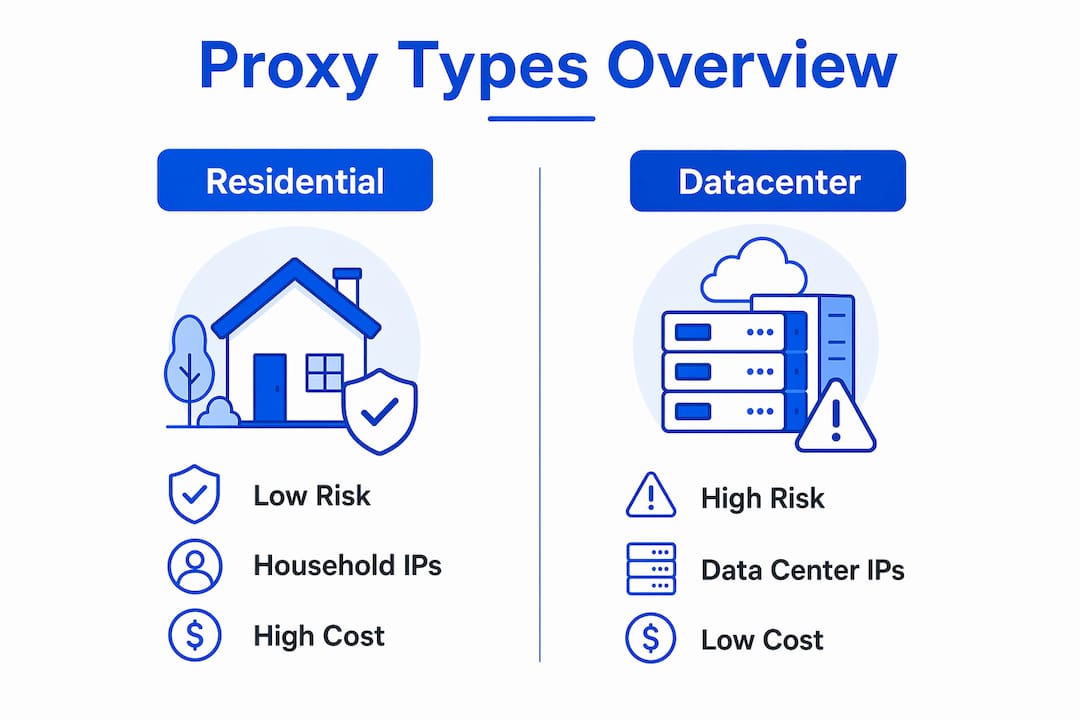
Residential proxies use IP addresses assigned to real households by ISPs like Comcast or AT&T. Because these IPs belong to genuine users, they carry strong reputation scores and pass most bot-detection checks. They are the standard choice for scraping Zillow and Redfin at moderate scale.
Mobile proxies operate through real carrier IP addresses shared via CGNAT (Carrier-Grade Network Address Translation). Mobile proxies from carriers like T-Mobile provide near-perfect success rates on strict real estate platforms because thousands of real users share the same IP block. This shared nature makes individual requests nearly impossible to isolate as bot traffic.
ISP proxies combine datacenter speed with residential IP registration. They are assigned by ISPs but hosted in data centers, giving you the throughput of a datacenter proxy with better reputation scores than a standard datacenter IP.
Datacenter proxies are the lowest-cost option but carry the highest detection risk. Major portals maintain blocklists of known datacenter IP ranges from providers like AWS and Google Cloud. They work for lower-security targets but fail quickly on Zillow-class platforms.
| Proxy Type | IP Source | Detection Risk | Best Use Case | Relative Cost |
|---|---|---|---|---|
| Residential | Household ISP | Low | Zillow, Redfin, Realtor.com | Medium |
| Mobile | Carrier (4G/5G) | Very Low | High-security portals, geo-specific data | High |
| ISP | ISP-registered, datacenter-hosted | Low to Medium | Mid-tier portals, high-volume scraping | Medium |
| Datacenter | Cloud providers | High | Low-security targets, internal testing | Low |
Pro Tip: When scraping region-specific portals, match your proxy’s geographic origin to the portal’s primary market. A geo-targeted residential IP prevents suspicious traffic flags that region-specific platforms trigger on out-of-area requests.
The competitive edge in real estate data aggregation comes not from raw IP quantity but from geo-accuracy and per-portal proxy routing. Assigning the wrong proxy type to a high-security portal wastes requests and burns IP reputation.
How api-driven data collection scales property analysis
Proxy infrastructure becomes most powerful when combined with structured automation. Tools like Apify’s All Property Scraper aggregate listing data from 40+ platforms and return unified JSON outputs with fields including price, number of bedrooms, geo coordinates, and days on market. This pay-per-result model eliminates the overhead of building and maintaining individual scrapers for each portal.
Here is how a structured proxy-aware data pipeline works in practice for real estate investment research:
- Platform selection by geography: The automation layer identifies which portals cover the target market, whether that is Zillow for U.S. residential, PropertyGuru for Southeast Asia, or Rightmove for the U.K.
- Proxy routing per portal: Each portal receives requests through a proxy type matched to its defenses. High-security portals get mobile or residential proxies; lower-security portals use ISP proxies to control costs.
- Data normalization: Raw outputs from different portals use inconsistent field names and formats. A normalization layer maps all inputs to a unified schema, making cross-platform comparison possible.
- Deduplication and freshness tracking: The same property often appears on multiple portals. Deduplication by address and MLS number prevents inflated comparable sales counts. Freshness timestamps flag listings that have not been updated in more than 24 hours.
- Trend analysis and alerting: Normalized data feeds into dashboards tracking price per square foot by ZIP code, average days on market, and rental yield by neighborhood.
| Data Field | Use in Investment Research |
|---|---|
| Price history | Identifies price reduction patterns and negotiation windows |
| Days on market | Signals demand levels and pricing accuracy in a submarket |
| Geo coordinates | Enables proximity analysis to schools, transit, and amenities |
| Rental estimates | Supports cap rate and cash-on-cash return calculations |
| Listing frequency | Tracks turnover rates as a proxy for neighborhood stability |
Geo-targeted residential IPs prevent suspicious traffic flags on region-specific portals, which is critical when aggregating cross-country data without quality loss. A European aggregator pulling data from German, French, and Spanish portals simultaneously needs proxies registered in each respective country to avoid triggering geo-mismatch alerts.
Best practices for ethical and legal proxy use in property research
Responsible proxy usage in real estate data collection is not optional. It is the difference between a sustainable long-term data operation and one that gets blocked or faces legal exposure.
The core compliance framework covers four areas:
- robots.txt: This file signals which parts of a site the operator prefers not to be crawled. Honoring robots.txt is voluntary under current law, but treating it as evidence of good faith matters in any legal dispute. Scraping paths explicitly disallowed in robots.txt increases legal risk.
- Terms of service: Most major portals prohibit automated data collection in their ToS. Bypassing authentication to access gated data crosses a clear legal line. Scraping publicly visible listing data sits in a grayer area, but you should review ToS before deploying at scale.
- Rate limiting and concurrency controls: Sending 500 concurrent requests to a single portal is not just a detection risk. It constitutes a denial-of-service load on the target server. Throttle request rates to mimic realistic user behavior, typically 1–5 requests per second per domain.
- GDPR and personal data: Scraping agent contact information, owner names, or other personal identifiers from European portals triggers GDPR obligations. If your workflow collects personal data, you need a lawful basis for processing it and a data retention policy. The data broker opt-out landscape is also relevant if your aggregated datasets include identifiable individuals.
Monitoring for silent failures is as much a compliance practice as a technical one. Serving stale or incorrect data to investors because your scraper silently failed is a liability. Build validation checks that flag anomalies like a ZIP code returning zero listings or a price field returning null.
Key takeaways
Proxy-supported real estate data collection works reliably only when proxy type, geo-accuracy, and content validation are matched to each target platform’s specific defenses.
| Point | Details |
|---|---|
| Match proxy type to platform | Use residential or mobile proxies for high-security portals like Zillow; reserve datacenter proxies for low-security targets. |
| Validate content, not just status codes | HTTP 200 responses can carry empty data; check for expected fields before marking a request successful. |
| Geo-accuracy drives data quality | Assign proxies from the same region as the target portal to avoid geo-mismatch detection flags. |
| Combine proxies with automation | Proxy-aware APIs like Apify’s All Property Scraper normalize multi-platform data into unified schemas for investment analysis. |
| Stay within legal and ethical limits | Honor robots.txt, respect rate limits, and apply GDPR compliance when scraping personal data from real estate portals. |
What 2026 anti-bot trends mean for real estate investors
The sophistication of anti-bot systems on real estate portals has accelerated faster than most investors realize. In 2025, behavioral biometrics were an emerging defense. In 2026, they are standard on every major U.S. portal. PerimeterX and HUMAN Security now analyze not just request frequency but the timing between page events, scroll behavior, and form interaction patterns.
What this means practically: the gap between a working proxy setup and a broken one is now measured in weeks, not months. Scrapers that ran cleanly on residential proxies in early 2025 started failing silently by mid-year as portals updated their fingerprinting logic. The professionals who stayed ahead were running per-portal proxy routing with browser fingerprint rotation, not just IP rotation.
My honest observation after tracking these systems closely: most real estate data teams underinvest in the validation layer and overinvest in raw IP volume. Buying 10,000 residential IPs does not solve a soft-block problem. Content validation and self-healing scraper logic solve it. The investors getting the cleanest, freshest data are the ones who treat proxy orchestration as an engineering discipline, not a commodity purchase.
The ethical dimension also deserves direct attention. The legal gray area around public data scraping is narrowing, not widening. Courts and regulators are paying closer attention to large-scale automated collection. Building compliance into your workflow from the start, including rate limiting, robots.txt review, and GDPR-aware data handling, protects your operation long-term. The professionals who treat ethics as an afterthought are the ones who eventually lose data access entirely.
— Eduard
Get reliable proxy coverage for real estate data
Real estate data collection demands proxies that perform consistently against the defenses Zillow, Redfin, and regional portals deploy in 2026. Hydraproxy provides residential proxies with genuine household IPs and worldwide mobile proxies using real carrier addresses from networks including T-Mobile, giving your scrapers the traffic profile of real users.
Hydraproxy’s infrastructure supports geo-targeted IP selection, rotating and sticky session control, and flexible pay-as-you-go billing with no monthly commitments. Whether you are running a single-market rental yield tracker or a multi-country listing aggregator, Hydraproxy’s proxy network scales to the task without locking you into fixed contracts. Explore the full product range and proxy pricing to find the configuration that fits your research workflow.
FAQ
What are proxies used for in real estate research?
Proxies route automated data requests through external IP addresses, allowing real estate professionals to collect listing data, price histories, and days-on-market figures from portals like Zillow and Redfin without triggering IP blocks.
Why do residential proxies outperform datacenter proxies on listing sites?
Residential proxies carry IP addresses assigned to real households, giving them strong reputation scores that pass anti-bot checks. Datacenter IPs are flagged quickly because portals maintain blocklists of known cloud provider IP ranges.
What is a soft block and why does it matter?
A soft block returns an HTTP 200 status but delivers empty or misleading data instead of real listings. Without content validation checks, soft blocks cause silent data failures that corrupt pricing models and investment analysis.
How do mobile proxies help with geo-specific property data?
Mobile proxies use genuine carrier IP addresses shared across thousands of real users via CGNAT, making individual scraping requests nearly undetectable. This makes them the strongest option for accessing accurate local listing data on strict regional portals.
Is scraping real estate listing data legal?
Scraping publicly visible listing data occupies a legal gray area that varies by jurisdiction and platform terms of service. Honoring robots.txt, avoiding authentication bypass, applying rate limits, and complying with GDPR when personal data is involved are the baseline practices for maintaining a legally defensible operation.