The Role of ISP Proxies in Digital Marketing

Most digital marketers assume any proxy will do the job. They grab a datacenter IP, run their ad verification or competitor scrape, and wonder why the data comes back incomplete or blocked. The role of ISP proxies in digital marketing is precisely to solve that problem. ISP proxies sit at a technical intersection that most proxy types cannot reach: they carry the trust signal of a residential IP while delivering the speed and session stability of dedicated server hardware. For marketers and data analysts who depend on accurate, uninterrupted data flows, that combination is not a nice-to-have. It is a requirement.
Table of Contents
- Key Takeaways
- The role of ISP proxies in digital marketing explained
- Key benefits for marketing operations
- Operational best practices for proxy selection
- When ISP proxies outperform other proxy types
- Real-world applications across marketing teams
- My take on ISP proxies as a long-term marketing asset
- How Hydraproxy supports your marketing proxy needs
- FAQ
Key Takeaways
| Point | Details |
|---|---|
| ISP proxies offer hybrid trust | They combine residential IP appearance with datacenter-level speed, reducing blocks on protected marketing targets. |
| Session persistence matters | Static ISP proxies maintain login state, cookies, and tokens, which is critical for account-based marketing workflows. |
| Proxy selection is performance-driven | Evaluate proxies by real success rates, latency, and session quality rather than vendor claims alone. |
| Private IPs outperform shared pools | Exclusive ISP proxies prevent reputation damage and bandwidth slowdowns during ad verification and competitor monitoring. |
| Proxy type should match the task | ISP proxies excel at stable logins and ad checks; rotating residential or mobile proxies fit high-volume scraping better. |
The role of ISP proxies in digital marketing explained
Before getting into strategy, the definition needs to be precise. An ISP proxy uses IP addresses that are registered to an internet service provider but routed through datacenter infrastructure. The result is a hybrid IP identity that automated detection systems classify as residential, while the underlying hardware delivers datacenter-grade throughput and uptime.
That distinction separates ISP proxies from two common alternatives. Datacenter proxies are fast and cheap, but their IP ranges are well-known to anti-bot systems, which means they get flagged or blocked on most major platforms. Residential proxies route traffic through real consumer devices, which gives them strong trust scores, but they rotate frequently, run slower, and cannot hold a session reliably. ISP proxies occupy the middle ground, and for digital marketing workflows, that middle ground is often exactly where you need to be.
The table below shows how the three proxy types compare across the metrics that matter most to marketing teams.
| Feature | Datacenter proxies | Residential proxies | ISP proxies |
|---|---|---|---|
| IP trust level | Low | High | High |
| Speed | Very fast | Moderate | Fast |
| Session persistence | Moderate | Low (frequent rotation) | High (static assignment) |
| Block rate on protected sites | High | Low to moderate | Low |
| Cost | Low | Moderate to high | Moderate |
| Best use case | High-volume scraping | Anonymity-sensitive tasks | Stable logins, ad verification |
Pro Tip: When evaluating ISP proxy providers, ask specifically whether the IPs are ASN-registered to a named ISP. Some vendors label datacenter IPs as “ISP proxies” without actual ISP registration, which eliminates the trust advantage entirely.
Key benefits for marketing operations
The ISP proxy benefits that matter most to marketing teams are not abstract. They show up in specific workflows where other proxy types fail.
Geo-targeted ad verification is one of the clearest examples. When you run campaigns across multiple regions, the ad creative, landing page, and bid price a user sees depend heavily on their IP location and network identity. Proxy-based viewing lets you confirm that your ads are displaying correctly in each target market, that geo-restrictions are working, and that localized content is rendering as intended. ISP proxies pass the network-layer checks that many ad platforms run, so you see what a real user in that location sees rather than a blocked or redirected page.
Session stability for account-based workflows is another area where ISP proxies outperform alternatives. Marketing automation tools, social media schedulers, and ad platform dashboards all rely on persistent login sessions. Static IP assignment maintains cookies and authentication tokens across requests, which prevents the session breaks that trigger security flags or force re-authentication. Rotating proxies cause exactly those breaks, which is why they are a poor fit for this category of work.

Competitor intelligence gathering also depends on clean, stable IPs. Competitor monitoring for pricing, keyword targeting, and creative testing requires consistent access to competitor pages without triggering rate limits or bans. An ISP proxy holds its identity long enough to simulate genuine browsing behavior, which means you collect data that reflects what a real customer would see rather than a sanitized version served to detected scrapers.
Other marketing tasks that benefit directly from using ISP proxies include:
- Multi-account management on ad platforms without cross-contamination between accounts
- SERP tracking from specific geographic locations for accurate local SEO data
- Ad fraud detection by verifying that placements appear on legitimate publisher pages
- Price monitoring for travel, e-commerce, and subscription services across regional markets
- Creative QA testing to confirm that dynamic ad content renders correctly for different audience segments
Pro Tip: For ad verification workflows, always use private ISP proxies rather than shared pools. Shared IPs that have been flagged by ad platforms will return inaccurate data or blocked responses, which defeats the purpose of the verification check entirely.
Operational best practices for proxy selection
Choosing the right ISP proxy is an engineering decision, not a purchasing one. Proxy evaluation should be data-driven, focusing on real-world success rates against protected targets rather than vendor marketing claims. Here is a practical sequence for selecting and testing ISP proxies for marketing use:
- Define the target environment. Identify the specific platforms, sites, or ad networks your workflow touches. Some platforms run aggressive bot detection; others are more permissive. Your proxy requirements differ significantly between the two.
- Request a trial or sample IPs. Before committing to a pool, test a sample against your actual targets. Measure the success rate, response latency, and whether sessions persist across multiple requests without triggering challenges.
- Verify ASN ownership. Confirm that the IPs are registered to a named ISP in the relevant country. Tools like IPinfo or WHOIS lookups can confirm this. IPs without genuine ISP ASN registration will not carry the trust signal you are paying for.
- Choose private over shared pools for critical tasks. Private ISP proxies prevent the reputation damage that comes from sharing an IP with other users who may have triggered blocks or rate limits on your target platforms.
- Manage session hygiene. Set realistic request pacing that mimics human browsing intervals. Pair your proxy sessions with consistent browser fingerprints, including matching user-agent strings, screen resolution, and language headers.
- Monitor and rotate strategically. Even static ISP proxies should be rotated periodically to prevent long-term flagging. Build rotation logic into your tooling, but keep sessions stable for the duration of each individual task.
Pro Tip: When testing proxy performance, use proxy buying criteria that include latency under load, not just baseline ping. A proxy that performs well on a single request may degrade significantly when you run concurrent sessions.
When ISP proxies outperform other proxy types
Not every marketing task calls for an ISP proxy. Understanding where they fit versus where other types are more appropriate saves both budget and operational complexity.
ISP proxies are the strongest choice when session continuity and IP trust are both required. Ad platform logins, social media account management, and ad verification all fall into this category. ISP proxies balance trust and control in a way that neither pure residential nor datacenter proxies can match, making them the default recommendation for sustained, identity-sensitive workflows.
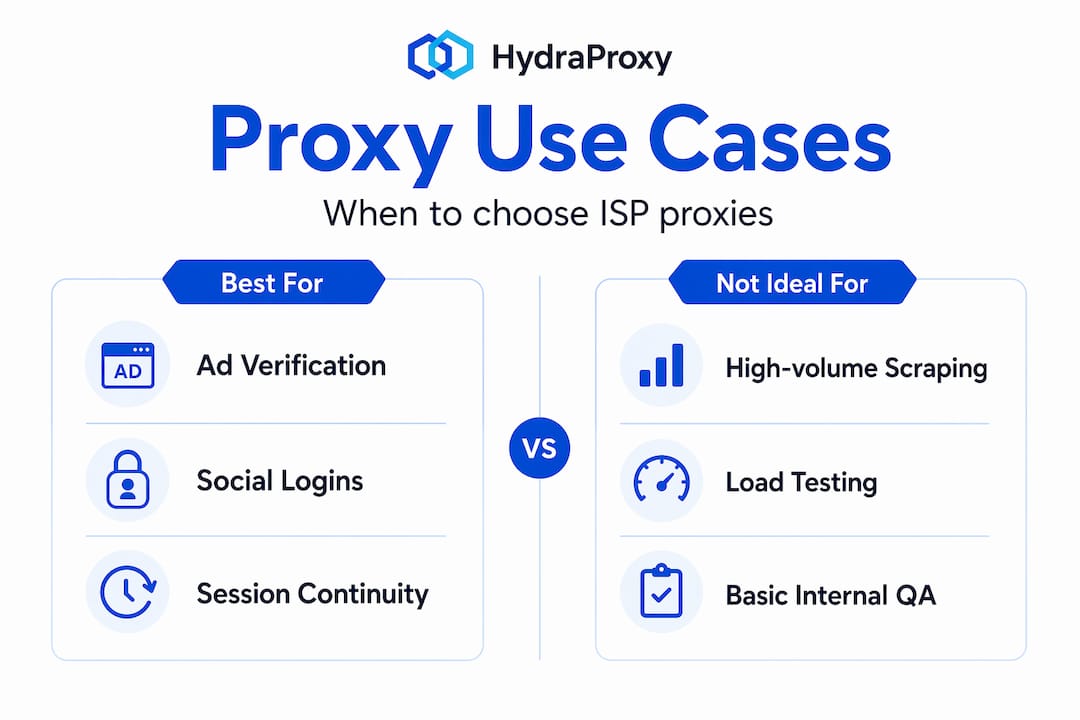
Rotating residential proxies are better suited for high-volume scraping tasks where session continuity is not required and geographic diversity matters more than speed. If you are collecting pricing data from thousands of product pages across multiple domains, the rotation helps distribute the load and avoid pattern detection. The tradeoff is slower throughput and less predictable session behavior.
Datacenter proxies remain useful for internal testing, load testing, and tasks where the target site does not run aggressive bot detection. They are the fastest and cheapest option, but their IP reputation is low on most major platforms.
The table below summarizes the tradeoffs across common marketing scenarios.
| Scenario | Best proxy type | Reason |
|---|---|---|
| Ad verification and placement checks | ISP proxy | High trust, stable session, low block rate |
| Multi-geo SERP tracking | ISP or residential proxy | Location accuracy with acceptable trust level |
| High-volume e-commerce price scraping | Rotating residential | Volume and geographic spread over stability |
| Social media account management | ISP proxy | Session persistence prevents security flags |
| Internal QA and load testing | Datacenter proxy | Speed and cost efficiency on non-protected targets |
| Competitor creative monitoring | ISP proxy | Stable identity for sustained monitoring tasks |
Cost is a real consideration. ISP proxies typically cost more than datacenter proxies but less than premium rotating residential networks at scale. For tasks where you need a small number of stable, high-trust IPs rather than a large rotating pool, ISP proxies often deliver better value per successful request. Scaling geo-targets without losing accuracy or stability is where the cost-to-performance ratio of ISP proxies becomes most apparent.
Real-world applications across marketing teams
Digital marketing teams at agencies, brands, and analytics firms are already using ISP proxies in ways that directly improve campaign measurement and data quality.
A performance marketing team running paid search campaigns across five countries can use ISP proxies to view each market’s SERP from a local IP, confirming that their ads appear in the correct position, with the correct ad copy, and that the landing page loads correctly for that region. Without ISP-level trusted IPs, the data they collect may reflect what a detected bot sees rather than what a real user sees, which distorts every optimization decision downstream.
A competitive intelligence analyst monitoring a rival’s pricing strategy needs to check product pages multiple times per day without triggering rate limits. Sustained competitor monitoring with stable session proxies allows that analyst to maintain consistent access, collect accurate price points, and feed clean data into their pricing models. Rotating proxies would break sessions mid-workflow and introduce gaps in the data timeline.
Anti-fraud teams at ad networks use ISP proxies to verify that publisher placements are legitimate, that ads appear on the declared domain, and that impressions are not being generated by bots. The same session stability for login workflows that benefits marketers also benefits verification tools that need to authenticate into ad platforms and pull placement reports.
Roles and industries that benefit most from ISP proxies in marketing include:
- Paid search and display advertising teams managing multi-geo campaigns
- SEO analysts tracking local rankings and SERP feature visibility
- Market research firms collecting pricing and product data at scale
- Brand protection teams monitoring unauthorized ad placements or trademark misuse
- Affiliate marketing networks verifying traffic quality and publisher compliance
My take on ISP proxies as a long-term marketing asset
I have worked with proxy infrastructure across enough marketing campaigns to have a clear opinion on where most teams go wrong. They treat proxy selection as a cost decision rather than a data quality decision. They buy the cheapest option, get blocked or served sanitized data, and then conclude that “proxies don’t work.” What they actually experienced was the consequence of using the wrong proxy type for the task.
ISP proxies are not the answer to every problem. But for the specific category of work that requires both trust and persistence, they are genuinely underused. Most marketing teams I have seen are either using datacenter proxies where they need residential trust, or they are using rotating residential proxies where they actually need session stability. ISP proxies sit in the gap between those two choices, and that gap covers a significant portion of real marketing workflows.
The trend I expect to see accelerate is tighter integration between proxy infrastructure and marketing analytics platforms. As anti-bot systems become more sophisticated, the quality of your proxy layer will directly determine the quality of your campaign data. Teams that treat proxy selection as a strategic infrastructure decision rather than a commodity purchase will have a measurable accuracy advantage over those that do not.
One thing I would push back on is the assumption that ISP proxies are only relevant for large teams with complex workflows. Even a solo analyst running competitive research or a small agency verifying client ad placements will see a direct improvement in data accuracy by switching from datacenter to ISP proxies for those specific tasks. The entry cost is low enough that the ROI calculus is straightforward.
— Eduard
How Hydraproxy supports your marketing proxy needs
Hydraproxy provides ISP and residential proxy networks built for the performance requirements that digital marketing teams actually face. The infrastructure supports static and rotating session configurations, giving you the flexibility to match proxy behavior to the specific task at hand, whether that is a sustained ad verification check or a high-volume data collection run.
For teams focused on competitor intelligence and market analysis, Hydraproxy’s proxy pool covers a wide range of geographic locations with clean IP reputation and reliable uptime. Session control options include both sticky and rotating modes, with multiple authentication methods and no monthly commitment requirements. The platform also offers a money-back guarantee, which means you can test performance against your actual targets before making a long-term infrastructure decision. If you need real-time data unification across your marketing stack, pairing a reliable ISP proxy layer with your analytics tools is a direct path to cleaner inputs and more accurate campaign decisions.
FAQ
What makes ISP proxies different from residential proxies?
ISP proxies use IP addresses registered to an ISP but routed through datacenter servers, combining residential-level trust with faster speeds and static session assignment. Residential proxies route through actual consumer devices, which gives them high anonymity but slower speeds and frequent IP rotation.
When should a marketer use ISP proxies instead of datacenter proxies?
Use ISP proxies when your target platform runs bot detection or serves different content based on IP trust level. Datacenter proxies are frequently flagged on ad platforms, social networks, and e-commerce sites, which makes them unreliable for ad verification, competitor monitoring, or account management.
How do ISP proxies improve ad verification accuracy?
ISP proxies pass network-layer legitimacy checks that ad platforms run, so the data you collect reflects what a real user sees rather than a version served to a detected bot. This is critical for confirming that geo-targeted creatives, landing pages, and ad placements are rendering correctly.
Are shared ISP proxies acceptable for marketing tasks?
For critical tasks like ad verification or account-based workflows, private ISP proxies are strongly preferred. Shared IP pools carry reputation risks from other users’ activity, which can result in blocks or inaccurate data returns on protected platforms.
How do you evaluate ISP proxy quality before purchasing?
Test sample IPs against your actual target platforms and measure success rate, response latency, and session persistence under realistic request conditions. Verify that the IPs carry genuine ISP ASN registration rather than relabeled datacenter ranges.