Why 4G Proxies Improve Scraping Success Rates

4G proxies are mobile IP addresses routed through real carrier networks, and they improve scraping success because platforms treat them with the same trust extended to ordinary smartphone users. Where datacenter IPs trigger immediate suspicion and residential IPs face growing scrutiny, carrier IPs occupy the top tier of platform trust hierarchies. For data professionals running competitive price monitoring, ad verification, or social media analysis, that distinction translates directly into fewer blocks, fewer CAPTCHAs, and more complete datasets. This article explains the technical reasons behind that advantage, where the benefits of 4G proxies are real versus overstated, and how to build scraping workflows that get the most from mobile infrastructure.
Why 4G proxies improve scraping success: the CGNAT advantage
The core technical reason 4G proxies outperform other proxy types is Carrier-Grade NAT, commonly abbreviated as CGNAT. CGNAT is a network architecture in which a mobile carrier assigns a single public IP address to dozens or even hundreds of simultaneous users. Every one of those users appears to originate from the same IP, yet all of them are real people browsing on their phones.
This creates a structural problem for anti-bot systems. Blocking a mobile IP risks collateral damage to hundreds of legitimate users, so platforms calibrate their enforcement policies to tolerate far more requests from mobile IPs than from any other source. The cost of a false positive is simply too high. That tolerance is the foundation of why 4G proxies enhance scraping outcomes at scale.
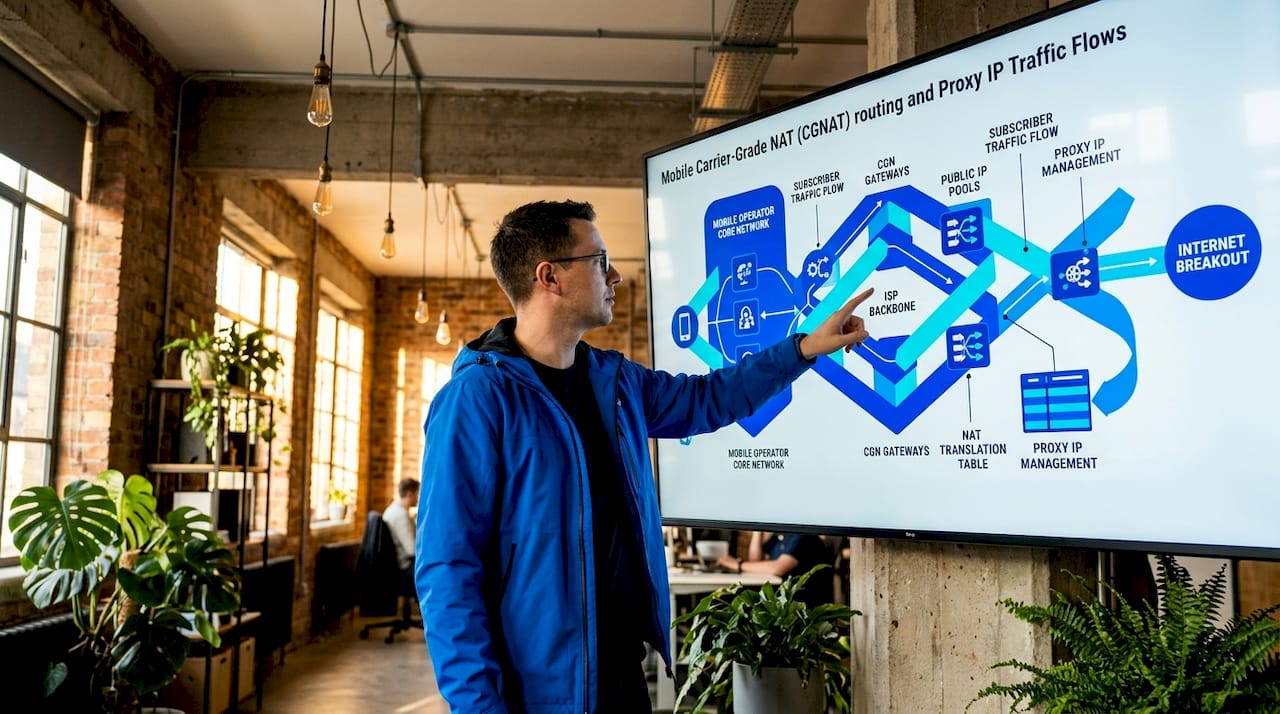
Carrier IPs receive the highest trust weighting in platform enforcement models, sitting above both residential and datacenter IPs in the classification hierarchy. Platforms evaluate the ASN (Autonomous System Number) and network type of every incoming connection before applying deeper behavioral checks. A carrier ASN clears that first filter with minimal friction.
The practical consequences are significant:
- Datacenter IPs are flagged at the ASN level before a single request is evaluated on its behavior.
- Residential IPs pass ASN checks but face increasing scrutiny as proxy providers scale their pools.
- Carrier IPs pass ASN checks and benefit from CGNAT-driven leniency in rate enforcement.
- Platform enforcement applies IP trust scoring in early session layers, which means mobile proxies clear the most consequential filter before behavioral analysis even begins.
Mobile IPs are not just harder to block. They are structurally protected by the same infrastructure that carriers use to serve millions of real subscribers.
How do 4G proxies compare to residential and datacenter proxies?
The performance gap between proxy types is measurable and significant. Mobile 4G proxies achieve a 95.4% success rate in web scraping, compared to 88.6% for residential proxies and 62.8% for datacenter proxies. That 32-point gap between mobile and datacenter is not marginal. For a scraping pipeline processing 100,000 requests per day, it represents tens of thousands of additional successful data points.
The difference is even sharper on aggressive targets. E-commerce sites like Amazon show datacenter proxy success rates below 43%, while mobile proxies sustain success above 94% on the same targets. Amazon’s anti-bot stack, which includes PerimeterX and proprietary fingerprinting, is specifically tuned to reject non-residential traffic. Mobile carrier IPs clear those filters where datacenter IPs fail entirely.
| Proxy type | Success rate | Block rate | Best use case |
|---|---|---|---|
| 4G mobile | 95.4% | Low | Account-level tasks, aggressive targets |
| Residential | 88.6% | Moderate | General scraping, geo-targeting |
| ISP | 93.8% | Low-moderate | Read-only monitoring, cost-sensitive tasks |
| Datacenter | 62.8% | High | Internal testing, low-security targets |
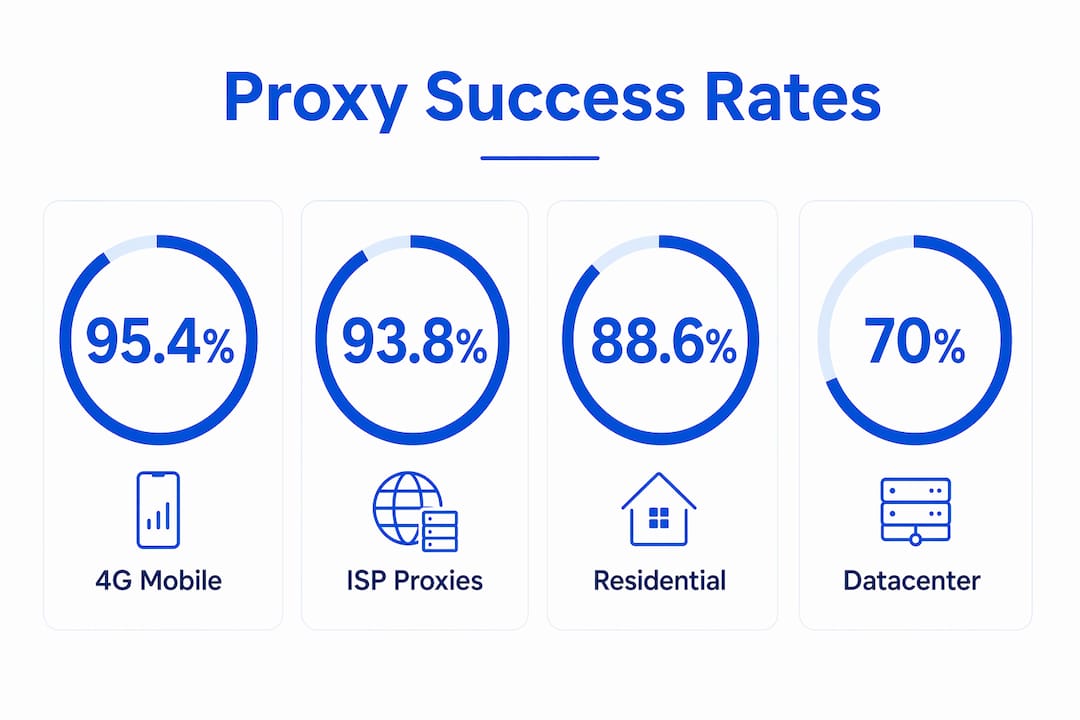
ISP proxies deserve a specific note here. ISP proxies offer roughly 93.8% success at approximately half the cost of mobile proxies, making them the better choice for read-only scraping where account interaction is not required. The advantages of using 4G proxies are most pronounced when the scraping task involves login sessions, form submissions, or platforms with aggressive mobile-specific trust signals.
Pro Tip: Before committing budget to 4G proxies across your entire pipeline, segment your targets by blocking aggressiveness. Run ISP proxies on low-security targets and reserve mobile proxies for platforms that consistently block other proxy types. This approach cuts costs without sacrificing success rates where they matter.
How does IP rotation work with 4G proxies?
4G proxies rotate IPs through two primary mechanisms: SIM card cycling and network reconnection events. Typical session duration ranges from 1 to 30 minutes, giving scraper operators the ability to balance IP freshness against session continuity. Understanding this rotation logic is critical to scraper design.
Here is how to structure your scraping workflow around 4G proxy rotation:
- Define session requirements first. Tasks involving login, cart interaction, or multi-step form completion require sticky sessions. Set session duration to match the expected workflow length, typically 10 to 20 minutes for most e-commerce or social media tasks.
- Use rotating sessions for stateless requests. Price checks, search result scraping, and public page monitoring do not require session continuity. Rotating sessions maximize IP diversity and reduce per-IP request density.
- Build retry logic with exponential backoff. Even with mobile proxies, occasional blocks occur. A retry handler that waits 2, 4, then 8 seconds between attempts prevents hammering a flagged IP and allows the rotation cycle to deliver a fresh address.
- Integrate with your provider’s API for session control. Providers like Hydraproxy expose session parameters through their proxy gateway, allowing programmatic control over rotation intervals without manual configuration.
- Monitor response headers, not just status codes. A 200 response with a CAPTCHA page is a soft block. Parse response content to detect honeypot pages, login redirects, and bot challenge pages that status codes alone will not reveal.
Key variables determining mobile proxy quality include pool size, carrier diversity, session stability, and IP rotation logic. Two providers offering “4G proxies” can deliver dramatically different results depending on how many unique carriers they cover and how cleanly their rotation handles session handoffs. Evaluating providers with real target benchmarks before scaling is not optional. It is the only reliable way to compare quality.
Pro Tip: Test your provider’s rotation behavior against your actual target sites before scaling. Send 500 requests through the proxy pool and measure the ratio of unique IPs returned. A healthy pool should deliver high IP diversity across that sample. Low diversity signals a small or poorly managed pool.
What are the limitations of 4G proxies for scraping?
4G proxies are not a universal solution, and treating them as one leads to wasted budget and misplaced confidence. Several limitations are worth understanding before committing to mobile infrastructure.
- Speed and latency variability. Mobile proxies can have slower speeds and higher latency than datacenter IPs due to mobile network congestion and geographic routing. A proxy routed through a congested urban carrier node can add 200 to 400 milliseconds of latency per request, which compounds significantly at scale.
- Cost per request. Mobile proxies carry a premium over residential and ISP proxies. For high-volume, low-complexity scraping tasks, the cost differential rarely justifies the performance gain.
- Behavioral detection still applies. Mobile proxies reduce CAPTCHA frequency but cannot bypass advanced behavioral detection and device fingerprinting. Anti-bot systems from vendors like Cloudflare, DataDome, and Akamai Bot Manager analyze mouse movement patterns, TLS fingerprints, and JavaScript execution behavior. An IP with a perfect carrier trust score will still be blocked if the scraper’s behavioral signature is robotic.
- Session stability under load. High-concurrency scraping through a small mobile proxy pool degrades session stability. If your pool contains 500 IPs and you are running 200 concurrent threads, IP reuse rates climb and detection risk increases.
- Provider quality variance. The market for mobile proxies includes providers with very different infrastructure quality. Evaluating providers through response headers and measured block rates on real targets is the only reliable method for assessing actual performance.
When not to use 4G proxies: static content scraping at high volume, internal QA testing, and any task where latency tolerance is below 100 milliseconds. For those scenarios, datacenter or ISP proxies deliver better cost-to-performance ratios.
Which scraping tasks benefit most from 4G proxies?
Matching proxy type to scraping task is the single most important decision in proxy selection. 4G proxies deliver their strongest advantages in specific scenarios where carrier trust signals are the deciding factor between success and a block.
The use cases where 4G proxies for data scraping deliver the clearest return on investment include:
- Social media scraping and account management. Scraping social media platforms or managing multiple accounts on Instagram, TikTok, or LinkedIn requires carrier-level trust scores to avoid detection and bans. Residential proxies increasingly fail on these platforms as providers’ ASNs become known.
- E-commerce price and inventory monitoring on aggressive platforms. Amazon, Walmart, and similar retailers deploy multi-layer bot detection that specifically targets non-mobile traffic. Mobile proxies sustain success rates above 94% where other proxy types fail. You can find a detailed breakdown of top mobile proxy providers to evaluate which networks perform best on these targets.
- Geo-targeted ad verification. Verifying that ads display correctly in specific carrier regions requires IPs that genuinely originate from those carrier networks. Datacenter IPs routed through a VPN endpoint do not replicate carrier-specific geo-signals.
- Search engine monitoring. Google and Bing apply stricter rate limits to non-residential traffic. Mobile proxies sustain higher request volumes before triggering rate enforcement.
- Web3 and airdrop participation. Many Web3 platforms apply device and carrier fingerprinting to prevent Sybil attacks. Carrier IPs provide the trust signals these platforms use to distinguish real participants from bots.
For read-only monitoring tasks where account interaction is not required, ISP proxies at roughly half the cost of mobile proxies are the more cost-effective choice. Understanding the full range of 4G mobile proxy use cases helps you allocate proxy budget where it generates the highest return.
Key takeaways
4G proxies improve scraping success because CGNAT-driven carrier trust scores clear the most consequential anti-bot filter before behavioral analysis begins, delivering success rates that datacenter and residential proxies cannot match on aggressive targets.
| Point | Details |
|---|---|
| CGNAT creates structural protection | Platforms tolerate more requests from mobile IPs to avoid blocking hundreds of real users sharing one IP. |
| Mobile proxies lead on success rates | 4G proxies achieve 95.4% scraping success versus 62.8% for datacenter proxies on comparable targets. |
| Match proxy type to task | ISP proxies at half the cost deliver 93.8% success for read-only scraping where account interaction is not needed. |
| Rotation design matters | Session duration, pool size, and carrier diversity directly determine detection rates and reliability. |
| Behavioral detection still applies | Mobile IPs do not neutralize fingerprinting or behavioral analytics from Cloudflare, DataDome, or Akamai. |
The case for starting with ISP proxies before going mobile
My honest assessment after working with proxy infrastructure across dozens of scraping pipelines: most teams reach for 4G proxies too early. The performance data is real. The 95.4% success rate is not marketing copy. But the cost premium is also real, and I have seen teams burn through proxy budgets on mobile IPs for tasks that ISP proxies handle just as well at half the price.
The pattern I recommend is incremental. Start with ISP proxies on every target. Measure actual block rates with your specific scraper configuration, not vendor benchmarks. Upgrade to mobile proxies only on targets where ISP proxies consistently fail. This approach forces you to understand your actual detection surface rather than assuming mobile proxies will compensate for a poorly designed scraper.
The other mistake I see regularly is treating proxy selection as a substitute for scraper design. A carrier IP with a perfect trust score will still get blocked if your scraper sends 50 requests per second from a single thread, ignores robots.txt timing signals, or uses a TLS fingerprint that matches no real browser. Proxy type determines your starting trust score. Scraper behavior determines whether you keep it.
One more thing worth noting: provider quality differences in the mobile proxy market are larger than most buyers expect. Pool size, carrier diversity, and rotation logic vary significantly between vendors. Benchmarking with real targets before committing to a provider is not due diligence. It is the minimum viable evaluation.
— Eduard
Hydraproxy’s 4G mobile proxy network for serious scraping
Hydraproxy operates a global pool of 4G mobile proxies built on real SIM cards across multiple carrier networks, with support for both rotating and sticky sessions. The infrastructure is designed for data professionals who need reliable IP rotation, carrier diversity, and session control without managing physical hardware. Hydraproxy’s mobile proxy infrastructure covers SIM card cycling, carrier-level IP assignment, and configurable session durations from 1 to 30 minutes. For teams running competitive market analysis, ad verification, or e-commerce monitoring, the worldwide mobile proxy pool provides geo-targeted access with no monthly commitments and flexible billing. If you are evaluating whether mobile proxies fit your current pipeline, Hydraproxy’s setup is worth benchmarking against your actual targets.
FAQ
Why do 4G proxies have higher scraping success rates?
4G proxies route traffic through real carrier networks subject to CGNAT, which causes platforms to apply lenient blocking policies to avoid impacting legitimate mobile users. This structural advantage gives mobile IPs a 95.4% scraping success rate compared to 62.8% for datacenter proxies.
Are 4G proxies better than residential proxies for scraping?
4G proxies outperform residential proxies on aggressive targets, achieving 95.4% success versus 88.6% for residential IPs. Residential proxies remain a cost-effective option for general scraping where carrier-level trust signals are not required.
Can 4G proxies bypass all anti-bot systems?
No. Mobile proxies reduce CAPTCHA frequency and clear IP-level trust filters, but advanced behavioral detection systems from vendors like Cloudflare and DataDome analyze TLS fingerprints and behavioral patterns that IP type alone cannot neutralize.
When should I use ISP proxies instead of 4G proxies?
ISP proxies deliver roughly 93.8% success at approximately half the cost of mobile proxies, making them the better choice for read-only scraping tasks that do not require account interaction or carrier-specific trust signals.
How do I evaluate a 4G proxy provider’s quality?
Measure pool size, carrier diversity, session stability, and IP rotation logic against your actual target sites. Send a test batch of requests and analyze response headers and block rates. Vendor benchmarks are a starting point, not a substitute for real-target evaluation.