What Is Rotating Proxy Explained: A Professional Guide

If you work with web data, privacy tools, or large-scale scraping, understanding what is rotating proxy explained in clear technical terms can directly affect the success of your operations. A rotating proxy is not simply a tool that swaps IP addresses. It is a traffic management system that routes each request through a different IP from a large proxy pool, making your activity look like it originates from many different users. This guide covers how rotation works under the hood, which proxy types are available, and how professionals apply these systems to avoid blocks, gather data, and maintain anonymity at scale.
Table of Contents
- Key Takeaways
- How rotating proxies work
- Types of rotating proxies
- Benefits and practical applications
- Best practices for using rotating proxies effectively
- Common challenges and how to overcome them
- My take on what most users overlook
- Why Hydraproxy fits your rotation needs
- FAQ
Key Takeaways
| Point | Details |
|---|---|
| Rotating proxy definition | A rotating proxy automatically assigns a different IP address to each request or session from a shared pool. |
| Core architecture | Most rotating proxy systems use a backconnect gateway that handles IP selection, routing, and load balancing. |
| Proxy types matter | Residential, mobile, and datacenter proxies differ in detection risk, cost, and ideal use cases. |
| Rotation strategy affects success | Per-request rotation maximizes anonymity; sticky sessions preserve continuity for login-dependent workflows. |
| Retry and quarantine logic | Automatically removing blocked IPs from the active pool significantly improves request success rates. |
How rotating proxies work
A rotating proxy automatically assigns a different IP from a shared pool to each new connection or request. From the perspective of any target server, every request appears to originate from a different user in a different location. The target server never sees the same source IP twice in rapid succession, which is precisely what makes this technology effective at avoiding rate limits and bans.
The underlying architecture is what separates a rotating proxy from a simple proxy list. Most rotating proxy systems rely on what is called a backconnect proxy infrastructure. A single gateway server accepts your outbound traffic, then selects an IP from a pool of backend nodes, routes your request through that node, and returns the response. The gateway also handles IP selection logic, load balancing across nodes, and failure detection.
Rotation can happen in three primary ways:
- Per-request rotation: Every HTTP request gets a new IP. This maximizes anonymity and minimizes the chance of triggering rate limits on high-frequency data collection tasks.
- Sticky sessions: The same IP is held for a defined period, typically between 1 and 30 minutes. This is useful when the target site requires session continuity, such as maintaining a logged-in state across multiple page loads.
- Time-based rotation: The IP is swapped after a set interval regardless of request count. This mirrors natural user behavior more closely and works well for long-running browsing simulations.
Pro Tip: If you are scraping paginated data that requires authentication, use sticky sessions for the duration of each paginated sequence, then rotate after completing each sequence. This preserves session tokens while still distributing your footprint across multiple IPs.
Understanding how to use rotating proxies starts with selecting the right rotation mode for your specific task, not defaulting to per-request rotation for every situation.
Types of rotating proxies
Not all rotating proxies carry the same detection risk or performance profile. The source of the IPs in the rotation pool determines how websites perceive and respond to your traffic.
| Proxy type | IP source | Detection risk | Best for |
|---|---|---|---|
| Residential | Real home devices via ISPs | Low | Scraping, geo-targeting, ad verification |
| Mobile | 4G/5G carrier networks | Very low | High-security sites, account management |
| Datacenter | Cloud servers | Medium to high | Speed-sensitive, low-security targets |
| ISP | Assigned to ISPs, hosted in DCs | Low to medium | High-speed residential-like traffic |
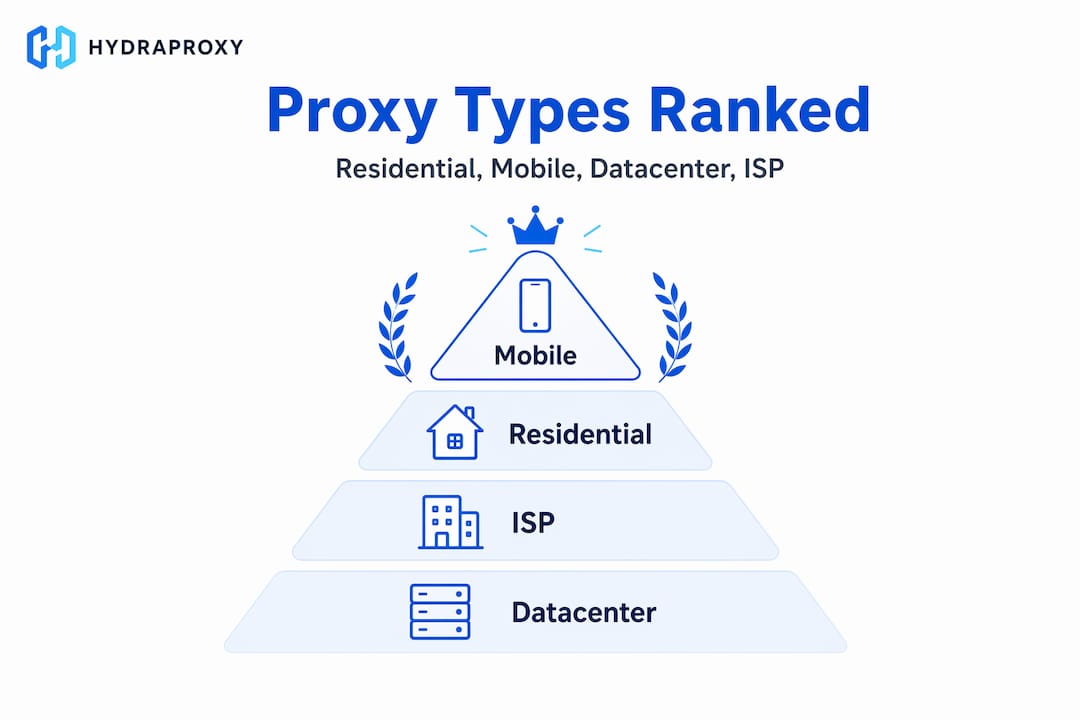
Residential rotating proxies pull from pools of IPs registered to real home internet connections. Because they appear as ordinary consumer traffic, they are the go-to option for bypassing geo-restrictions and accessing location-specific content. Rotating residential proxies help bypass geo-restrictions by cycling through IPs from a geographically diverse pool, which supports use cases like SEO rank monitoring across different regions and travel fare aggregation.

Mobile rotating proxies operate through carrier networks and rotate on a schedule tied to the carrier’s DHCP lease cycle. Mobile proxies rotate IPs typically every 5 to 30 minutes, with rotation triggered by network reconnection or toggling airplane mode, completing in as little as 3 to 10 seconds. Because carrier-grade NAT already pools millions of users behind shared IPs, mobile proxies carry higher success rates and are far less likely to be flagged compared to datacenter alternatives. You can read more about this in Hydraproxy’s guide on mobile proxy IP rotation.
Datacenter rotating proxies deliver speed and lower cost but carry a higher detection risk because their IP ranges are registered to cloud providers, which anti-bot systems recognize and flag more aggressively. They work well for targets with minimal bot protection.
ISP proxies combine the speed of datacenter infrastructure with residential-grade IP assignments, making them a practical middle ground for high-throughput tasks that still require a clean IP reputation.
Benefits and practical applications
The advantages of using rotating proxies extend well beyond basic anonymity. Here is how professionals apply them across real workflows:
-
Avoiding IP bans during large-scale data collection. When hundreds of requests come from a single IP, most servers respond with a block or a CAPTCHA. Rotating proxies reduce IP ban collisions by distributing requests across many IPs, mimicking the footprint of many different users rather than one automated system.
-
Web scraping and data extraction. Rotating proxies are the standard infrastructure for professional web scraping operations. They allow you to collect pricing data, product listings, search results, and public records at scale without triggering throttling or bans.
-
Ad verification. Ad fraud detection and verification requires checking how ads render in different geographic regions and across different ISP types. Rotating residential proxies let you view ad placements as a local user would without alerting the ad platform.
-
SEO monitoring across regions. Search results vary by location. Rotating through IPs from specific countries or cities lets you monitor keyword rankings as seen by users in those markets, giving you accurate, unmanipulated data.
-
Market research and competitive intelligence. Pulling pricing data, inventory levels, and product availability from competitor sites requires consistent, undetected access. Rotation keeps your collection pipeline running without interruption.
-
Bypassing geo-restricted content. For individuals and teams who need access to content limited to certain regions, rotating proxies from the target region provide reliable access without the latency issues of traditional VPNs.
-
Maintaining privacy online. For individuals concerned about tracking, rotating IPs limit how effectively data brokers and analytics platforms can build persistent profiles tied to a single IP address.
The benefits of rotating proxies are most visible when the alternative, a static IP, is compared directly. A static IP used repeatedly against a well-protected site will be identified and blocked within minutes. A rotating pool of hundreds or thousands of IPs spreads that signal thin enough that no single IP accumulates enough suspicious behavior to trigger a ban.
Best practices for using rotating proxies effectively
Knowing the technology is one thing. Getting consistent results from it requires deliberate configuration choices.
-
Match your rotation strategy to the task. Per-request rotation is ideal for anonymous scraping of public data. Sticky sessions are necessary for anything that requires authentication or multi-step form submissions.
-
Vary more than just the IP. IP rotation that is too fast or inconsistent can trigger anti-bot systems through session token anomalies. Rotate your user agent strings and browser headers alongside your IP to create a coherent request profile.
-
Set realistic request intervals. Proper throttling and delay mimic natural traffic patterns and reduce CAPTCHA triggers. Flooding a server at maximum speed, even through rotating IPs, signals automation.
-
Implement retry and quarantine logic. Intelligent proxy rotation uses retry and quarantine logic to avoid reusing IPs that triggered 429 or 5xx error responses. When an IP is flagged, it gets removed from the active pool temporarily, and a fresh IP steps in. This design pattern directly improves your success rate over sustained collection runs.
-
Monitor session continuity needs. Not every target site tracks sessions by IP alone. Some use cookies, tokens, and fingerprinting in combination. Know your target’s anti-bot approach before deciding whether rotating frequently helps or hurts your workflow.
Pro Tip: Treat your proxy provider as a gateway with built-in retry and quarantine mechanisms. If your current setup does not automatically cycle away from blocked nodes, you are losing significant throughput to preventable failures.
Common challenges and how to overcome them
Even a well-configured rotating proxy setup will encounter friction. Here are the most common obstacles and how to address them:
-
CAPTCHAs and challenge pages. These typically appear when request patterns look automated regardless of IP diversity. The fix is to slow down, vary headers, and use residential or mobile IPs with better trust scores.
-
Slow rotation on mobile proxies. Proxy rotation must balance session persistence with IP diversity to avoid detection. Mobile proxies rotate more slowly than residential ones by nature. Plan your workflow around these intervals rather than forcing faster rotation that can break session continuity.
-
Inconsistent node performance. Not every IP in a pool performs equally. Some nodes will be slow, misconfigured, or already flagged by popular target sites. A quarantine system, as described above, handles this automatically. Without it, you will need to monitor and flush bad nodes manually.
-
Legal and ethical considerations. Rotating proxies are legal tools, but how you use them matters. Scraping data protected by terms of service or accessing private systems without authorization carries legal risk. Stick to publicly available data and respect robots.txt files and rate limits set by the target server.
-
Balancing speed with server respect. High-volume scraping can degrade the performance of target servers. Building in deliberate delays is both an ethical practice and a technical one; aggressive crawling is one of the fastest ways to get your IP pool flagged site-wide.
My take on what most users overlook
I’ve spent a lot of time working with rotating proxy setups, and the most consistent mistake I see is treating IP rotation as a complete solution on its own. Rotating IPs matter, but sophisticated anti-bot systems do not just watch IP addresses. They track behavioral signals: mouse movement patterns, JavaScript execution timing, TLS fingerprints, and the sequence of requests within a session.
In my experience, the users who run into the most persistent blocks are the ones who bought into the idea that a large IP pool alone would protect them. What actually works is a layered approach. Rotate IPs intelligently, but also match realistic user agent patterns, introduce natural timing variation, and select proxy types that match the trust level required by your target.
I’ve also found that most people underestimate mobile proxies. Because carrier networks naturally pool large numbers of users behind shared IPs, mobile traffic looks indistinguishable from organic browsing. When a target site is blocking residential proxies, switching to mobile often resolves it immediately. The rotation mechanics also feel more natural because they mirror how real devices actually reconnect to carrier networks.
The other thing I’d push back on is the preference for maximum rotation speed. Faster is not always better. Flipping IPs on every request while your session tokens and browser fingerprint remain static is a contradiction that anti-bot systems catch quickly. Align every layer of your request profile, not just the IP.
— Eduard
Why Hydraproxy fits your rotation needs
Hydraproxy offers residential, mobile, and ISP rotating proxies built for professionals who need reliable, high-anonymity access at scale. Their infrastructure includes large, geographically diverse IP pools with configurable rotation intervals, so you can dial in per-request rotation or sticky sessions depending on your workflow. The platform supports multiple authentication methods, API integration, and session control out of the box, without requiring long-term commitments or complex setup. For those focused on web data collection, market research, or ad verification, Hydraproxy’s residential proxy network provides real user-like traffic that passes scrutiny from even aggressive anti-bot systems. If mobile rotation is your priority, their mobile proxy servers deliver carrier-grade IP rotation with the session management controls your workflows require.
FAQ
What is a rotating proxy?
A rotating proxy is a proxy system that assigns a different IP address from a shared pool to each new request or session. This prevents any single IP from accumulating enough traffic to trigger rate limits or bans on target servers.
How do rotating proxies differ from static proxies?
A static proxy uses a single fixed IP address for all requests, while a rotating proxy cycles through many IPs. Static proxies are easier to detect and block; rotating proxies distribute traffic to reduce that risk. You can review the full comparison of proxy types for more detail.
Which type of rotating proxy is hardest to detect?
Mobile rotating proxies are the hardest to detect because they operate through carrier networks that naturally share IPs across millions of real users, making automated traffic virtually indistinguishable from organic mobile browsing.
Can rotating proxies get blocked?
Yes. Rotating proxies can still be blocked if request patterns are too aggressive, if IP ranges are already flagged by the target site, or if session tokens and browser fingerprints contradict the IP rotation. Pairing rotation with realistic request timing and header variation significantly reduces this risk.
What rotation strategy should I use for web scraping?
Use per-request rotation for anonymous public data collection, and sticky sessions for any workflow that requires authentication or multi-step navigation. Combine both with retry and quarantine logic to automatically replace blocked IPs without interrupting your pipeline.