Why ISP Proxies Aid Security Research Effectively

Security researchers operate in an environment where IP reputation has long been the default line of defense. That assumption is breaking down fast. Understanding why ISP proxies aid security research requires looking at how modern proxy infrastructure has fundamentally changed the traffic patterns that detection systems were built to recognize. ISP proxies, technically known as static residential proxies or ISP-assigned proxies, sit at the intersection of datacenter speed and residential legitimacy, making them both a research tool and a threat modeling subject that no serious analyst can afford to ignore.
Table of Contents
- Key Takeaways
- Why ISP proxies aid security research: definitions and distinctions
- How IP reputation controls fail against ISP proxy traffic
- Using ISP proxies for security analysis and defense testing
- Best practices for ISP proxy use in security research
- ISP proxies versus other proxy types for security research
- My perspective on ISP proxies and the future of security research
- Start your ISP proxy research with Hydraproxy
- FAQ
Key Takeaways
| Point | Details |
|---|---|
| IP reputation alone is insufficient | Nearly 4 in 10 IPs hitting security sensors are residential IPs, rendering IP blocklists unreliable on their own. |
| ISP proxies mimic legitimate traffic | ISP-assigned IPs appear as real user traffic, making them ideal for testing detection systems under realistic conditions. |
| Fingerprint continuity matters | Rotating IPs without matching session and fingerprint data creates detectable anomalies that undermine research accuracy. |
| WebRTC leaks expose real IPs | Browsers can reveal actual IP addresses during testing via WebRTC, compromising research integrity if not mitigated. |
| Controlled egress improves data quality | A default-deny egress architecture with allowlisting prevents accidental data leakage during proxy-based research. |
Why ISP proxies aid security research: definitions and distinctions
Before getting into methodology, you need a clear picture of what separates ISP proxies from their counterparts. The industry term is static residential proxy or ISP proxy, and it refers to IP addresses assigned directly by an Internet Service Provider to a real ISP customer block, but hosted on datacenter infrastructure. The result is an IP that passes reverse DNS lookups as a genuine ISP subscriber address while delivering the speed and uptime of a server-grade connection.
That combination matters because the three major proxy categories behave very differently in practice.
Datacenter proxies originate from cloud hosting ranges like AWS or Azure. They are fast and cheap, but IP reputation databases flag them almost immediately. Any security control worth its configuration will block datacenter IP ranges by default.
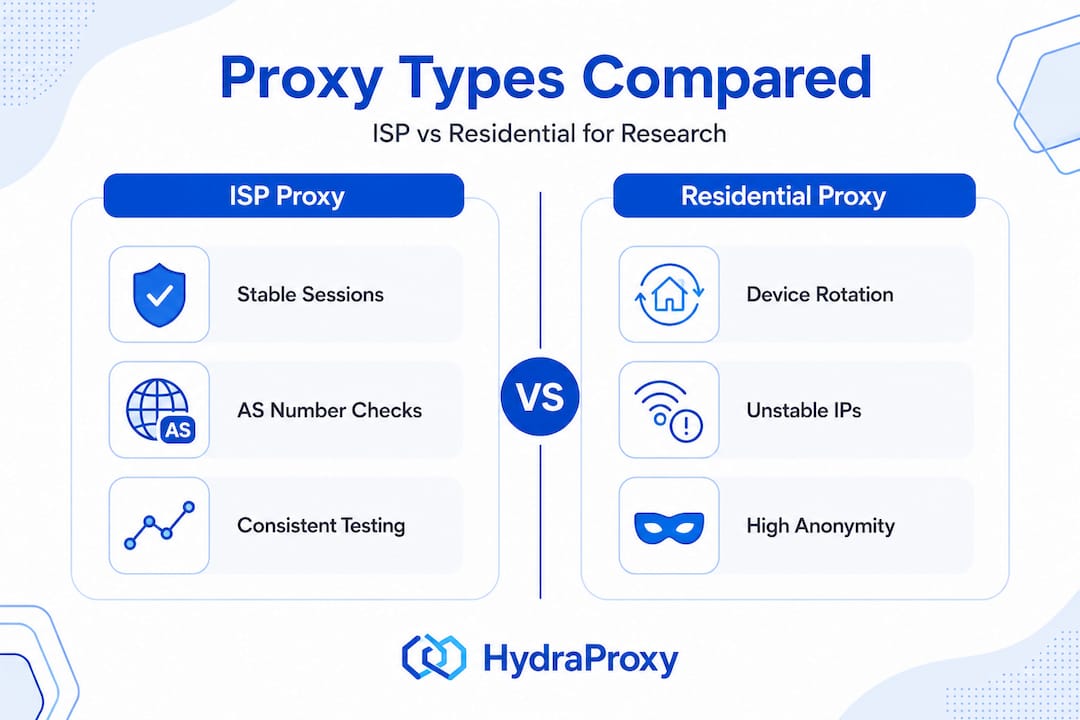
Residential proxies route traffic through actual consumer devices, using IPs assigned to home broadband or mobile connections. They look highly legitimate but are often sourced from residential proxy networks that rely on end-user consent, or worse, compromised devices. They are slow, unpredictable, and ethically complex.
ISP proxies occupy a distinct middle ground. They carry real ISP-registered IP blocks, pass AS number checks, and sustain consistent performance. For security researchers, that means you get traffic that behavioral systems treat as a legitimate user, without the instability of residential peer networks. ISP proxies provide persistent, legitimate-looking IP identities that reduce ban risk compared to datacenter proxies while maintaining far greater speed and reliability than residential alternatives.
| Proxy type | IP origin | Speed | Anonymity level | Stability |
|---|---|---|---|---|
| Datacenter | Hosting ranges | Very high | Low | High |
| Residential | Consumer devices | Low to medium | Very high | Low |
| ISP (static residential) | ISP-assigned, datacenter hosted | High | Very high | Very high |
How IP reputation controls fail against ISP proxy traffic
IP reputation systems operate on a core assumption: if you can classify an IP address by its origin and history, you can infer intent. That assumption collapses when attackers and researchers alike route traffic through ISP proxy networks.
Nearly 4 in 10 IPs hitting enterprise security sensors in 2026 were residential or ISP-assigned addresses, completely undermining the IP blocklist model. These IPs belong to real subscriber ranges. No reputation feed flags them preemptively, and no geographic heuristic separates them from ordinary user traffic. GreyNoise observed billions of malicious sessions at the network level that were indistinguishable from legitimate user activity.
“Defenders should treat anonymized residential and ISP proxy traffic as a direct extension of botnet infrastructure, not a simple evasion tactic.” — Bitsight threat research team
The malware ecosystem makes this worse. About 20% of residential proxy exit nodes communicated with malware sinkholes over a 55-day monitoring window, with a consistent 14 to 21% overlap with multiple malware families. Sinkhole telemetry revealed 15 to 26% overlap with families including Vo1d, Badbox, and RootSTV. This means that when you test your detection pipeline against ISP and residential proxy traffic, you are simulating the same infrastructure that real threat actors use.
The practical implication for your research is significant. Behavioral analytics and anomaly detection systems that rely on IP classification will generate false negatives at scale when faced with ISP proxy traffic. A security research methodology that does not account for this is measuring a threat model that does not reflect real-world attack traffic. The importance of proxies in cybersecurity research, specifically ISP proxies, is therefore directly tied to the gap between what IP reputation systems can see and what they cannot.

Using ISP proxies for security analysis and defense testing
The constructive side of ISP proxies in security research is where the real value becomes clear. When you route simulated attacker traffic through ISP-assigned IPs, you test your security controls against the exact traffic profile that malicious actors use in production environments.
Here is how security teams apply ISP proxies across specific research disciplines:
- WAF rule validation. Web Application Firewalls tuned to block datacenter ranges will not perform the same way against ISP proxy traffic. Running fuzz tests through ISP proxies, as outlined in application fuzzing methodology, reveals rule gaps that lab-condition testing with datacenter IPs never exposes.
- IP reputation auditing. You can measure the actual block rate of your threat intelligence feeds against ISP proxy IPs. The delta between expected and actual block rates tells you how much of your coverage depends on IP origin rather than behavioral signals.
- Behavioral detection model training. Because ISP proxy traffic looks like legitimate users, it stress-tests the behavioral features your models rely on. Sessions routed through ISP proxies force your detection pipeline to depend on timing patterns, request sequences, and fingerprint signals rather than IP classification shortcuts.
- Geo-heuristic validation. ISP proxies with geographic targeting let you verify whether your geo-based access controls perform correctly for users in specific regions, without deploying physical test infrastructure.
- Social engineering defense benchmarking. Combined with behavioral security models, ISP proxy traffic simulation helps you evaluate how phishing and credential stuffing attacks appear at the network layer when they originate from legitimate-looking IPs.
Pro Tip: When using ISP proxies to stress-test WAF rules, run parallel control tests with known datacenter IPs. The performance gap between the two gives you a quantified measure of how much your WAF depends on IP origin classification versus actual request analysis.
The benefits of ISP proxies for this type of research extend beyond detection testing. When you instrument your analytics pipeline to process ISP proxy traffic accurately, you build detection logic that is resistant to the evasion techniques real attackers already use.
Best practices for ISP proxy use in security research
Effective proxy-based research is not just about selecting the right IP type. Execution quality determines whether your measurements reflect real-world conditions or introduce artifacts that distort your findings.
-
Match IP rotation to session logic. Security platforms detect the same browser fingerprint accessing sites from dozens of IPs in seconds and flag it as automation immediately. Rotate IPs only when session context changes, and pair each IP change with a corresponding change in browser fingerprint, user agent, and cookie jar.
-
Eliminate WebRTC leaks before testing. Browsers expose local IPs via ICE candidate gathering during WebRTC sessions, even when all other traffic routes through the proxy. Disable WebRTC at the browser or OS level, or use a testing environment where WebRTC is blocked by policy.
-
Use a controlled egress proxy architecture. A default-deny egress setup with explicit allowlisting prevents your research traffic from contacting unintended endpoints and ensures measurement integrity. This is particularly critical when your research involves active scanning or probing of external systems.
-
Select sticky sessions for stateful testing scenarios. For research that involves authenticated sessions, account takeover simulations, or multi-step attack chain testing, sticky IP sessions maintain the appearance of a consistent user identity across the entire session lifecycle.
-
Audit your proxy provider’s IP sourcing. ISP proxy quality varies significantly by provider. Confirm that the IPs you are using are genuinely ISP-assigned and not quietly reclassified datacenter ranges. Run AS number checks against the proxy IPs before building research protocols around them.
Pro Tip: Before any active research session, run your proxy configuration through a leak-check endpoint that reports IP, WebRTC candidates, TLS fingerprint, and DNS resolver. Any inconsistency between these signals is exactly what target systems use to flag proxy usage.
ISP proxies versus other proxy types for security research
Choosing the right proxy type for a specific research task requires understanding where each type performs well and where it falls short.
| Research scenario | Best proxy type | Reason |
|---|---|---|
| WAF and anti-bot bypass testing | ISP proxy | Appears as legitimate ISP user traffic |
| Large-scale IP reputation auditing | Residential proxy | Broad IP pool covers more ASNs |
| High-speed vulnerability scanning | Datacenter proxy | Maximum throughput, acceptable for non-evasive scans |
| Stateful session and account testing | ISP proxy (sticky) | Persistent identity across multi-step request sequences |
| Mobile threat simulation | Mobile proxy (4G/5G) | Matches carrier IP ranges for mobile-specific controls |
| Geographic access control validation | ISP proxy with geo-targeting | Consistent, verifiable regional identity |
ISP proxies outperform residential proxies in research scenarios that require stable, repeatable sessions. Residential proxies cover more IP diversity but introduce noise from unstable connections and ethically questionable sourcing. Datacenter proxies remain appropriate for high-volume scanning where evasion is not the research objective. The advantages of ISP proxies over datacenter options become especially pronounced once your research requires passing IP reputation checks as a precondition for accurate measurement.
My perspective on ISP proxies and the future of security research
I have spent a significant amount of time working through the practical side of proxy-based security research, and the gap between how researchers think about ISP proxies and how threat actors actually use them is still surprisingly wide.
Most teams I have seen treat proxy selection as a secondary decision, something to sort out after the research design is done. That order is backwards. The proxy type you choose determines whether your measurements are valid, not just convenient. If you design a detection test using datacenter IPs and then claim your security controls are hardened, you have not tested the threat model that actually matters in 2026.
What I have found most underappreciated is the ethical dimension. ISP proxies from legitimate providers are clean and auditable. But the residential proxy ecosystem is demonstrably intertwined with malware infrastructure, and researchers who do not verify their provider’s sourcing may be using botnet capacity without knowing it. That is not just an ethical problem. It is a research integrity problem, because botnet-sourced IPs behave differently from genuine ISP addresses.
The trend I see accelerating is behavioral signal prioritization. IP classification will not disappear, but the strongest security research teams are already building pipelines where IP reputation is one input among many, not the decision point. ISP proxy testing is exactly the right tool for stress-testing that transition. The teams that adapt their research methodology to account for ISP proxy traffic will have far more accurate threat models than those who still assume datacenter IP blocklists represent the real attack surface.
— Eduard
Start your ISP proxy research with Hydraproxy
Hydraproxy provides security researchers and analysts with access to a global network of genuine ISP proxies, residential proxies, and mobile proxies designed for high-integrity testing and threat analysis. If you are running WAF validation, behavioral detection research, or IP reputation auditing, the quality and sourcing of your proxy IPs directly determines the accuracy of your results. Hydraproxy’s worldwide ISP proxy network gives you persistent, ISP-assigned IPs with session control options, including sticky and rotating configurations, backed by clean sourcing you can verify. You can also explore residential proxy fundamentals to round out your understanding of proxy IP types and their role in security testing workflows.
FAQ
What makes ISP proxies different from residential proxies?
ISP proxies use IP addresses assigned by real Internet Service Providers but hosted on datacenter infrastructure, giving them both the legitimacy of residential IPs and the speed of server connections. Residential proxies route through actual consumer devices, which introduces instability and sourcing complexity not present with ISP proxies.
Why do ISP proxies matter for WAF and anti-bot testing?
Testing WAF rules with datacenter IPs does not reflect real attack traffic, since most rules already block known hosting ranges. ISP proxies replicate the legitimate-looking traffic profile that attackers use, exposing rule gaps that only appear under realistic conditions.
How do WebRTC leaks affect proxy-based security research?
WebRTC sessions can expose a researcher’s real IP address through browser ICE candidate gathering, even when all other traffic routes through the proxy. Disabling WebRTC or using a controlled browser environment is required to maintain research accuracy.
Can rotating ISP proxies create detection artifacts?
Yes. Pairing frequent IP rotation with a static browser fingerprint signals automation to anti-bot systems. Effective rotation requires matching each IP change with corresponding changes in session context, fingerprint, and request headers.
Are ISP proxies sourced ethically compared to residential proxies?
ISP proxies from reputable providers use genuinely ISP-assigned IP blocks without relying on consumer device networks. Residential proxy networks have documented overlap with malware ecosystems, making sourcing verification a critical step before using them in any research context.